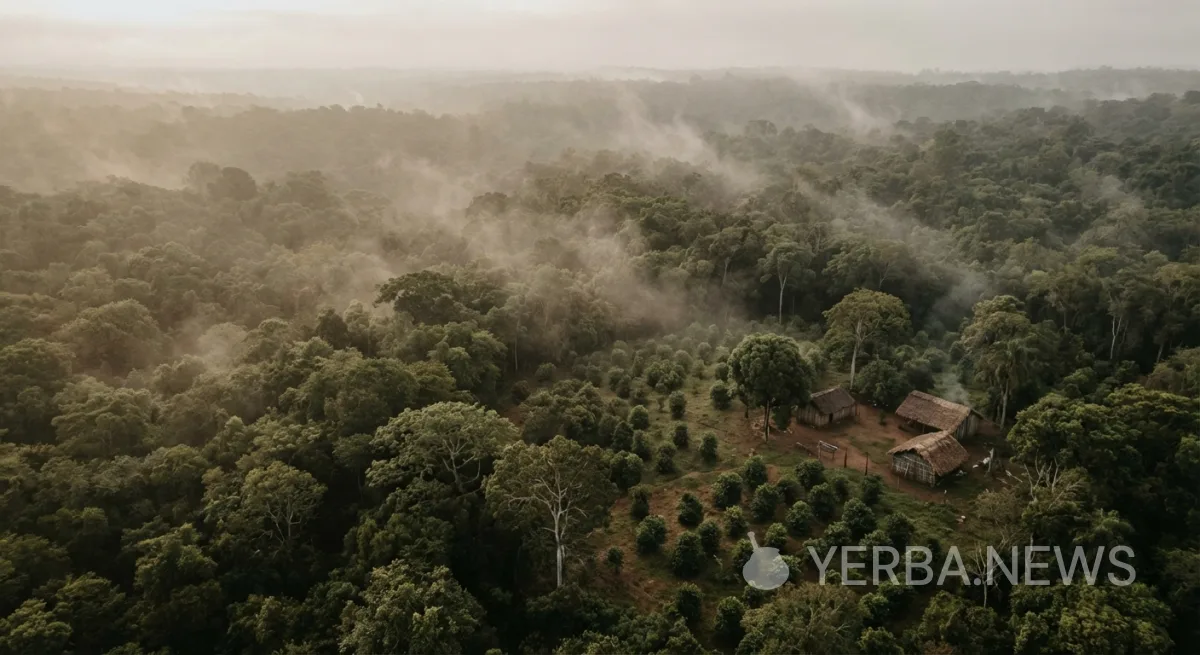
In the district of Capiibary, in Paraguay's San Pedro department, the Ava Guarani community of Ka'aty Miri San Francisco maintains a model that predates the modern sustainability movement by centuries: cultivating yerba mate as a sacred and medicinal plant within a 400-hectare tract of native forest that they have protected against the surrounding pressures of soy monoculture, cattle ranching, and logging. For the Ava Guarani, yerba mate — Ilex paraguariensis — is not a commodity. It is ka'a, the sacred plant, a spiritual and medicinal herb inseparable from the forest ecosystem in which it evolved and the cultural system that has cultivated it for generations.
The PROEZA Model
The Ka'aty Miri community's forest protection is now supported by PROEZA (Poverty, Reforestation, Energy, and Climate Change), a project funded by the Green Climate Fund and implemented with technical assistance from the Food and Agriculture Organization of the United Nations (FAO). PROEZA works with indigenous and rural communities across Paraguay to enhance yerba mate cultivation and processing techniques while simultaneously advancing reforestation, carbon sequestration, and climate resilience. The project's approach is notable for what it does not do: it does not ask indigenous communities to adopt industrial agricultural methods. Instead, it strengthens the ancestral cultivation techniques that the Ava Guarani already practice — shade-grown cultivation under the forest canopy, natural composting, manual harvesting, and sun and air drying — and integrates them into a formal climate-finance framework that assigns economic value to the forest carbon that the community's stewardship preserves.
The 2026 Harvest Milestone
A concrete milestone approaches in 2026: yerba mate seedlings planted by PROEZA-supported communities in May 2022 are expected to reach productive maturity, producing their first harvestable leaf. This four-year maturation timeline — during which the plants grow from seedlings into small trees capable of sustaining annual harvest — represents a patient, long-cycle agricultural investment that contrasts sharply with the annual crop cycles of soy and corn that dominate Paraguayan agriculture. The 2026 harvest will provide the first empirical data on yield, quality, and economic viability for PROEZA's agroforestry model, potentially validating the hypothesis that shade-grown, forest-integrated yerba mate can provide competitive household income while maintaining forest cover.
The Atlantic Forest Context
Ka'aty Miri's 400 hectares are embedded within what remains of the Atlantic Forest — one of the most biodiverse and most endangered ecosystems on Earth. The Atlantic Forest once covered approximately 1.3 million square kilometers across eastern South America (Brazil, Argentina, and Paraguay); today, approximately 12–15% of the original forest cover remains, fragmented into isolated patches surrounded by agriculture. In Paraguay, the loss has been particularly severe: the country lost over 90% of its eastern forest cover in the second half of the 20th century, driven by Brazilian agricultural colonization and the expansion of mechanized soy farming. Guyra Paraguay, a conservation nonprofit, has partnered with Mbya Guaraní communities in a parallel initiative to plant yerba mate trees in degraded forest areas — using the crop itself as the economic incentive for forest restoration. The logic is circular but powerful: the forest that yerba mate needs to grow (it evolved as an understory species in the Atlantic Forest) is the same forest that the indigenous communities need to preserve their way of life — and the yerba mate harvest provides the income that makes forest preservation economically viable against the relentless pressure of soy conversion.
Paraguay's yerba mate cultural landscape has been nominated for UNESCO recognition, an acknowledgment that the relationship between the Guaraní peoples, the Atlantic Forest, and Ilex paraguariensis constitutes a cultural heritage of universal significance. Whether the PROEZA model can scale — from individual communities like Ka'aty Miri to a national strategy for forest-integrated agriculture — will depend on whether the 2026 harvest data demonstrates that shade-grown yerba mate can compete economically with plantation-grown alternatives. If it can, the Ava Guarani's 'sacred plant' may prove to be one of the rare cases in which cultural tradition, ecological preservation, and economic development genuinely align.