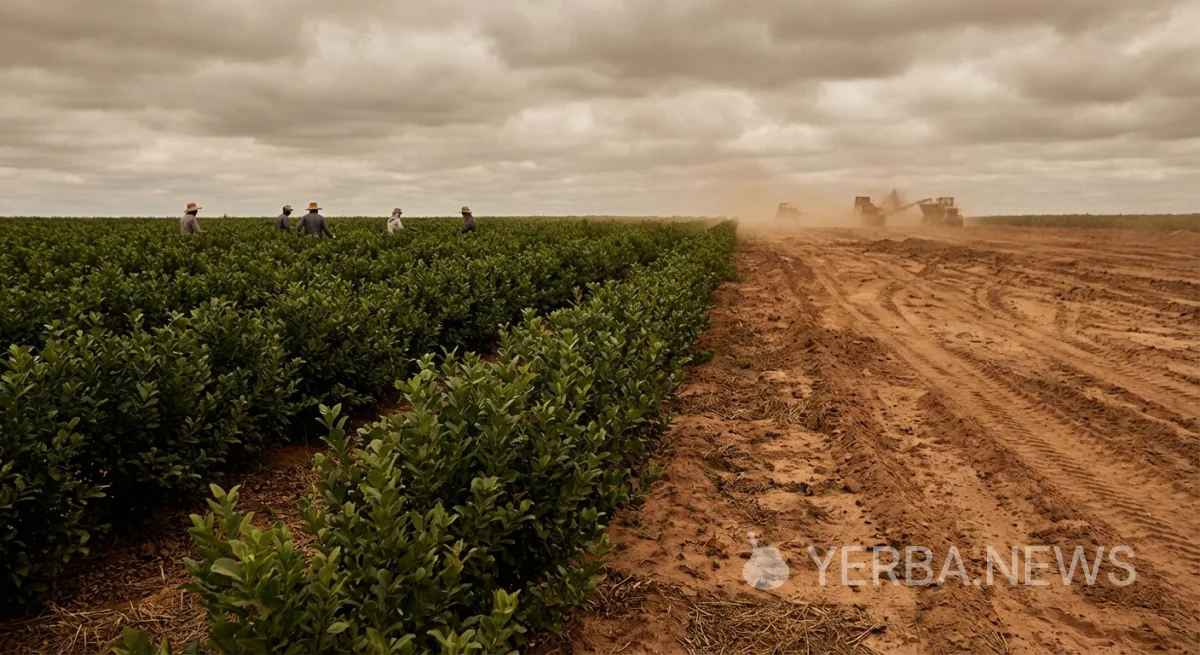
In the Paso Yobai district of Paraguay's Guairá department, two extractive economies are locked in a conflict that has drawn the attention of Amnesty International and the United Nations. On one side are artisanal and commercial gold miners, whose operations use mercury and cyanide to extract gold from the region's geology. On the other are smallholder yerba mate farmers, whose century-old cultivation tradition is being contaminated by the mining runoff — and who face criminal prosecution when they protest.
The Contamination Crisis
Gold mining in Paso Yobai has escalated dramatically over the past decade, drawing both small-scale artisanal miners and larger operations. The extraction process relies on cyanide leaching and mercury amalgamation — techniques that are efficient for gold recovery but catastrophic for surrounding ecosystems. In January 2024, a dam collapse at a mining operation released cyanide-laced water into a local stream, killing fish and contaminating adjacent pastures and yerba mate fields. Scientific studies conducted in 2023 and 2024 documented the presence of mercury in soils, water sources, and — critically — in the leaves of yerba mate plants grown in the affected area. Buyers have rejected contaminated batches, leaving producers with unsaleable harvests and no recourse.
Despite Paraguay's status as a signatory to the Minamata Convention — the international treaty that aims to phase out mercury use in mining — enforcement in Paso Yobai remains virtually nonexistent. The UN Special Rapporteur on toxics and human rights visited the region in 2022 and confirmed that mercury and cyanide use in mining operations was causing severe environmental impacts affecting yerba mate production.
The Criminalization of Resistance
When yerba mate farmers organized to resist the encroachment of mining into their production zones, the response was not government intervention against the polluters but criminal charges against the protesters. In March 2025, Vidal Brítez Alcaraz — president of the Santa María Association of Yerba Mate Producers in Paso Yobai — was detained and charged with 'grave coercion' in connection with his activism against mining pollution. Amnesty International issued an Urgent Action on his behalf, characterizing his detention as a reprisal for his environmental advocacy and his defense of the right to a clean environment.
Vidal Brítez Alcaraz is being prosecuted for defending his community's right to a clean environment and opposing mining operations that are contaminating yerba mate crops with mercury and cyanide.
— Amnesty International, Urgent Action AMR 35/9208/2025, March 2025
A Conflict Between Two Paraguas
The Paso Yobai conflict exposes a tension at the heart of Paraguay's economic development model. The country sits within the native range of Ilex paraguariensis, and yerba mate is deeply embedded in Paraguayan national identity — tereré, the cold-water version of mate, was inscribed on UNESCO's Intangible Cultural Heritage list in 2020. Yet the gold deposits beneath the same soil create an extractive incentive that overwhelms environmental protections. The Yerba Mate Producers' Association has advocated for the creation of protected zones designated exclusively for yerba mate cultivation — a land-use classification that would prohibit mining within yerba-growing areas. The proposal has not been adopted.
The case has drawn coverage from international outlets including the Taipei Times, CIVICUS Monitor, and El Otro País, a Paraguayan investigative journalism outlet. For the global yerba mate industry, the Paso Yobai crisis is a supply-chain risk: if contamination spreads to a larger fraction of Paraguayan production, the country's yerba mate exports — which reached 7,279 tons in 2024, spanning 26 countries — could face reputational damage and regulatory scrutiny in destination markets.