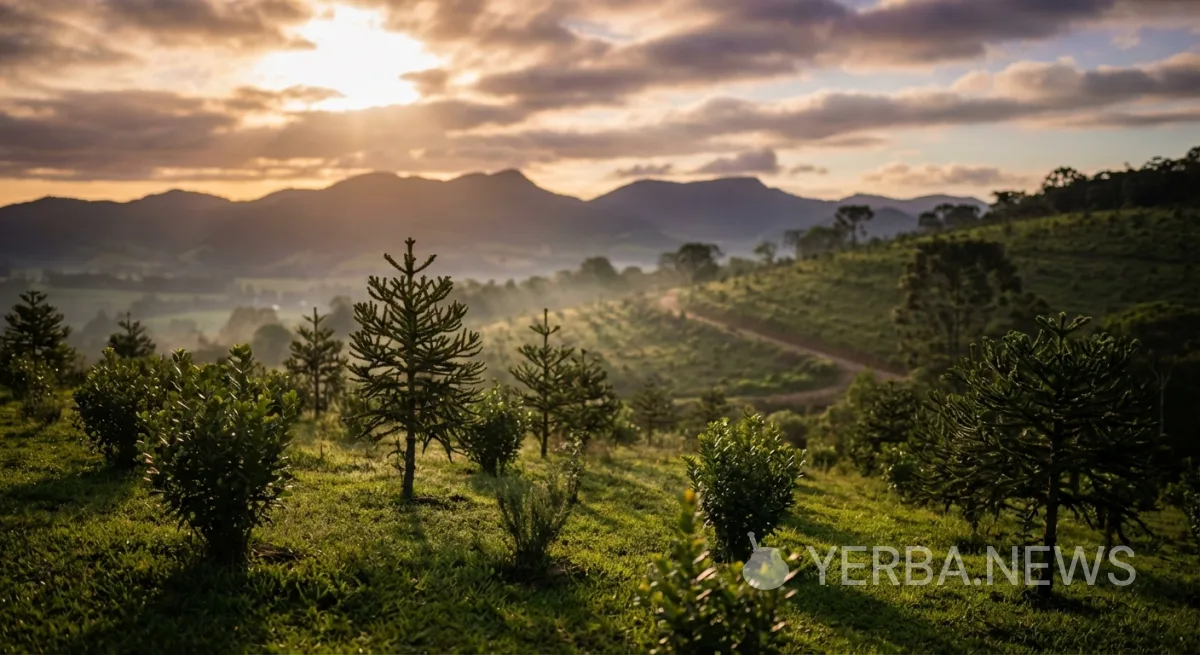
In the highlands of Santa Catarina — one of three Brazilian states where the Araucaria Forest once defined the landscape — a restoration project with an ambitious name is testing whether commercial agriculture and ecological reconstruction can coexist on the same piece of land. 'Mais Floresta com Araucária' (More Forest with Araucaria), reported by Click Petróleo e Gás in February 2026, is restoring 292 hectares of degraded Atlantic Forest through agroforestry systems that pair yerba mate with native Araucaria angustifolia and other indigenous tree species.
The Araucaria Crisis
Araucaria angustifolia — the Brazilian pine, with its distinctive umbrella-shaped crown — is critically endangered. Once covering 200,000 square kilometers across southern Brazil, the species' range has been reduced by approximately 97% due to logging, agricultural expansion, and urbanization. Today, the Araucaria Forest exists primarily in fragments, many of which are too small and isolated to sustain viable populations of the endemic species that depend on them, including the endangered Vinaceous-breasted Parrot (Amazona vinacea).
The Agroforestry Model
The project's approach is based on the ecological insight that Ilex paraguariensis — the source plant for yerba mate — evolved as an understory species within Araucaria Forests. By restoring the original canopy structure (Araucaria trees, plus associated species like laurels, cedars, and cinnamon trees) and planting yerba mate beneath it, the system mimics the forest's natural architecture while producing a commercially valuable crop. The 292 hectares under restoration across the project's footprint represent a mosaic of planting schemes calibrated to local soil conditions, slope, and remnant vegetation.
Multi-Product Revenue Streams
A critical innovation of the project is its multi-product design. Participating farmers are not dependent on a single commodity but can harvest yerba mate leaves (beginning approximately five years after planting), pinhão — the large, starchy seeds of the Araucaria tree, which are a traditional food in southern Brazil and sell at premium prices during the winter festival season — native fruits, medicinal herbs, and, on longer rotations, sustainable timber from the companion tree species. This diversification reduces financial risk for participating farmers and creates economic incentives for maintaining forest cover that pure conservation easements cannot match.
Scaling the Model
The project operates alongside a constellation of similar initiatives — Solidaridad's yerba mate program in neighboring Paraná, the Martin Bauer Group's sustainable sourcing partnership in São Mateus do Sul, and the Trillion Trees partnership with BirdLife International — that are collectively building the evidence base for market-driven forest restoration. The question is no longer whether agroforestry can restore degraded landscapes; the evidence from these programs demonstrates that it can. The question is whether the economic incentives and supply-chain infrastructure can be assembled at a pace commensurate with the ecological urgency.