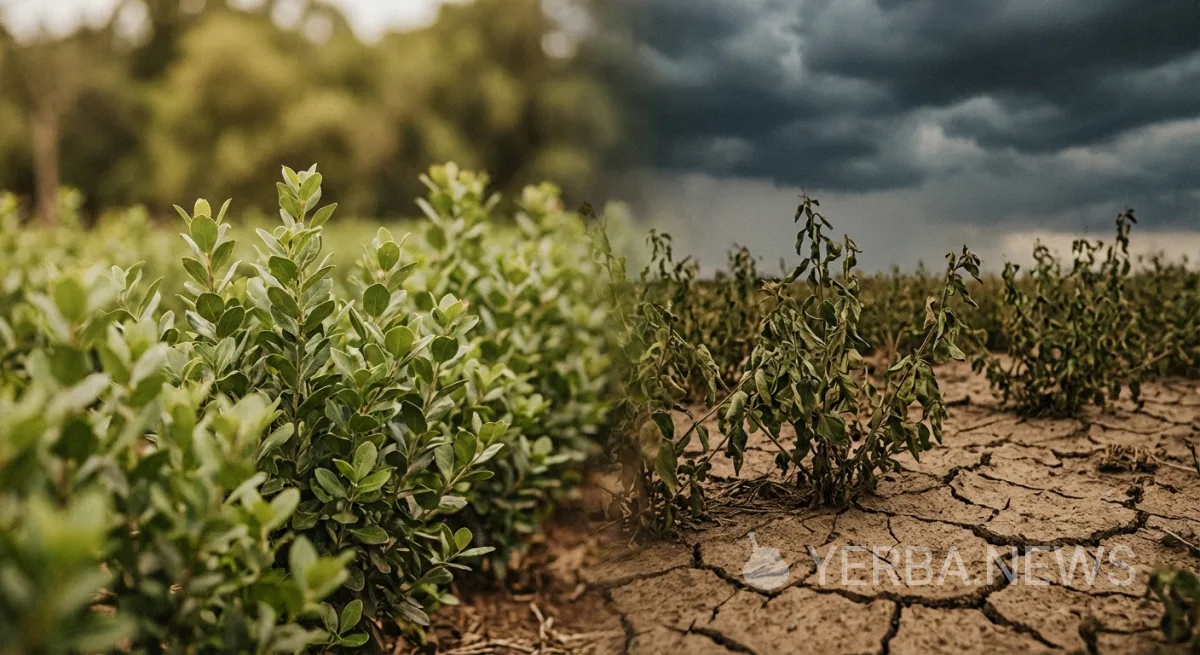
A 2024 study by a team of Brazilian researchers, published in a peer-reviewed journal and covered by the environmental journalism platform Dialogue Earth, has modeled the projected impact of climate change on the global distribution of viable yerba mate cultivation zones. The findings paint a concerning picture: under multiple greenhouse gas emission scenarios, the area suitable for commercial Ilex paraguariensis production is expected to contract significantly in Paraguay and northeastern Brazil — regions that currently account for a substantial share of the world's supply.
Temperature and Rainfall Thresholds
Yerba mate is a subtropical species that thrives within a relatively narrow climatic envelope. Optimal cultivation requires average annual temperatures between 15°C and 22°C and minimum annual rainfall of approximately 1,200 mm distributed across the growing cycle. The 2024 modeling study projects that rising average air temperatures — combined with altered precipitation patterns, including more intense but less frequent rainfall events — will push significant portions of current production zones beyond these thresholds within the coming decades.
A Geographical Shift
The study's most striking projection concerns the direction of the shift: as conditions become less favorable in the northeast of the current growing range (particularly in Paraguay and the Brazilian states of Mato Grosso do Sul and São Paulo), the zone of climatic suitability is expected to migrate southwestward. Uruguay — which has not historically been a significant yerba mate producer — emerges in the modeling as a potentially viable new production region, which could foster an entirely new national industry.
Adaptation Strategies
The researchers recommend accelerated investment in shade-grown cultivation systems — which moderate canopy temperatures and retain soil moisture more effectively than sun-exposed monocultures — as well as breeding programs targeting heat-tolerant and drought-resistant Ilex paraguariensis genotypes. Research in southern Brazil has already demonstrated that shade-grown yerba mate can achieve a negative carbon balance, absorbing more CO₂ than it releases, while simultaneously providing a more stable income for family farms in a changing climate. Whether these adaptation measures can be deployed at sufficient scale to offset the projected losses remains an open and urgent question for the global yerba mate industry.