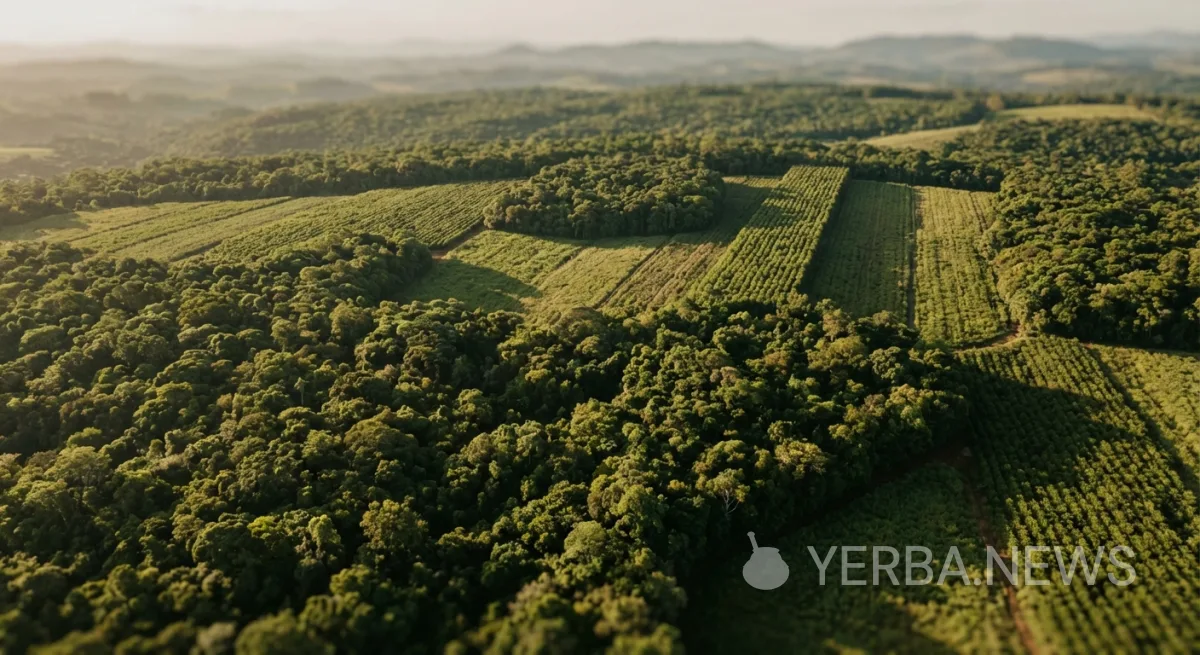
The Atlantic Forest — Mata Atlântica — once stretched across 1.3 million square kilometers along Brazil's coast and deep into Argentina and Paraguay. Today, roughly 12% of the original forest remains, fragmented into thousands of isolated patches separated by pasture, soybean fields, and urban sprawl. Reconnecting these fragments is one of the most urgent conservation priorities in the Southern Hemisphere, but it faces a fundamental economic obstacle: the land between the fragments belongs to farmers who need income, and the market has historically rewarded them for doing precisely the opposite of reforestation — clearing land for monoculture crops.
The Solidaridad Model: Mate as Connector
Since 2019, Solidaridad — an international development organization with a 50-year history of market-based solutions to sustainability challenges — has been running a yerba mate program in southern Brazil that attempts to resolve this tension. The model is conceptually simple: work with family farmers in Paraná and Santa Catarina to establish yerba mate agroforestry systems on degraded land that separates Atlantic Forest fragments. Because Ilex paraguariensis is a shade-tolerant understory species that thrives beneath a forest canopy, planting it requires — rather than precludes — the restoration of tree cover. The farmer gets a cash crop; the forest gets a corridor.
How It Works on the Ground
In practice, Solidaridad's technical teams work with farming families to design multi-species planting schemes in which yerba mate is interplanted with native canopy trees (including Araucaria angustifolia, the iconic Paraná pine), fruit-bearing species, and timber trees. The resulting agroforestry systems typically reach functional canopy closure within five to seven years, at which point the yerba mate plants begin producing their first commercial harvests. The farmer's income diversifies across multiple products — erva-mate, pinhão (Araucaria seed), native fruits, and eventually timber — while the landscape transitions from open pasture to a multi-layered forest system that provides habitat connectivity for wildlife.
The Economic Case for Restoration
What distinguishes Solidaridad's approach from conventional reforestation projects is its insistence on economic viability. The organization provides technical training, access to seedlings, and — critically — market linkages that connect participating farmers with buyers willing to pay premium prices for shade-grown, agroforestry-sourced yerba mate. The program explicitly targets farmers who are currently earning marginal returns from degraded pasture or low-productivity crops, demonstrating that agroforestry can deliver competitive income while simultaneously generating ecosystem services that monoculture cannot.
The Solidaridad program sits alongside other complementary initiatives, including the 'More Forest with Araucaria' project in Santa Catarina — which has restored 292 hectares of degraded Atlantic Forest through agroforestry systems that include yerba mate and other native species — and partnerships between the Martin Bauer Group and Bad Heilbrunner in the São Mateus do Sul region of Paraná. Together, these programs are building a critical mass of evidence that market-driven agroforestry can scale reforestation in ways that subsidy-dependent conservation models have struggled to achieve.