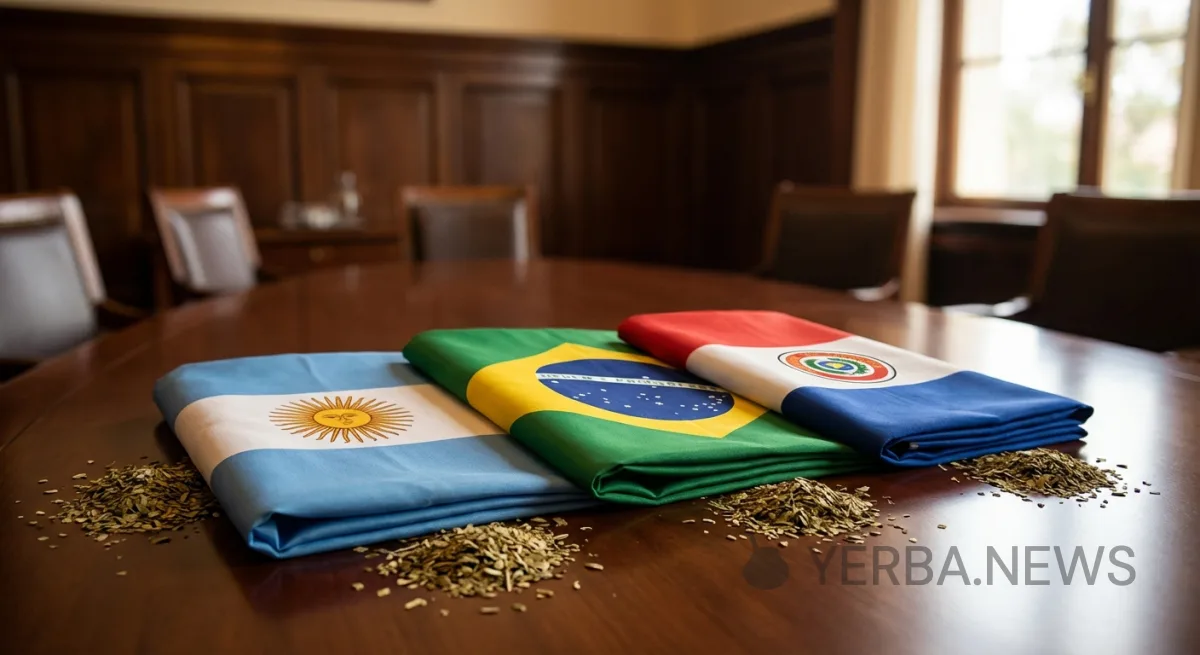
In a development that reflects the yerba mate industry's growing ambition to compete on the global stage, producers from Argentina, Brazil, and Paraguay have established the South American Federation of Yerba Mate Producers — a trinational body that aims to coordinate export promotion, protect producer interests, and present a unified category identity to international markets. The formation of the federation, reported by MercoPress, marks the first time that the three countries responsible for virtually 100% of the world's Ilex paraguariensis production have created a formal institutional framework for cross-border cooperation.
Why a Federation, Why Now
The timing of the federation's formation reflects two converging pressures. First, the global yerba mate market is expanding rapidly — projected to reach US$3 billion by 2030 — but the category remains fragmented, with no equivalent of the International Coffee Organization (ICO) or the Tea & Herbal Association of Canada that can speak authoritatively on behalf of the entire supply chain. Second, producers in all three countries face common challenges — climate change affecting yields, farmgate prices that often fall below production costs, and competition from large processors with disproportionate market power — that require collective bargaining and coordinated policy advocacy.
The Coordination Agenda
The federation's stated objectives include coordinating export promotion at international trade fairs, harmonizing quality standards across the three producing countries, developing shared sustainability certifications, and advocating for producer-friendly trade policies in destination markets. Each country brings distinct strengths to the partnership: Argentina contributes the largest production volume and the most developed export infrastructure; Brazil offers the most extensive germplasm research and agronomic science capacity; Paraguay contributes the deepest cultural heritage and the most advanced UNESCO recognition framework (tereré's Intangible Cultural Heritage inscription, plus the Tentative World Heritage listing for the Yerba Mate Cultural Landscape).
Precedents and Prospects
Trinational commodity federations have a mixed track record in South America. OPEC-style production cartels have failed for most agricultural commodities, and coordination among countries with different economic policies (Argentina's regulatory tradition vs. Brazil's market orientation vs. Paraguay's smallholder focus) is inherently complex. The federation's success will likely depend on whether it can deliver tangible benefits to its members — preferably in the form of increased demand, improved farmgate prices, or reduced trade barriers — rather than serving primarily as a diplomatic symbol.
For the global yerba mate category, the federation represents a maturation signal. When an industry moves from fragmented national promotion to coordinated international representation, it typically indicates that the category has reached sufficient scale and strategic importance to justify institutional investment. Coffee, tea, and wine all underwent similar institutionalization phases as they transitioned from regional beverages to global commodities. The South American Federation of Yerba Mate Producers suggests that yerba mate is entering this phase — and that the three nations that grow it intend to shape, rather than merely react to, the trajectory of its global expansion.