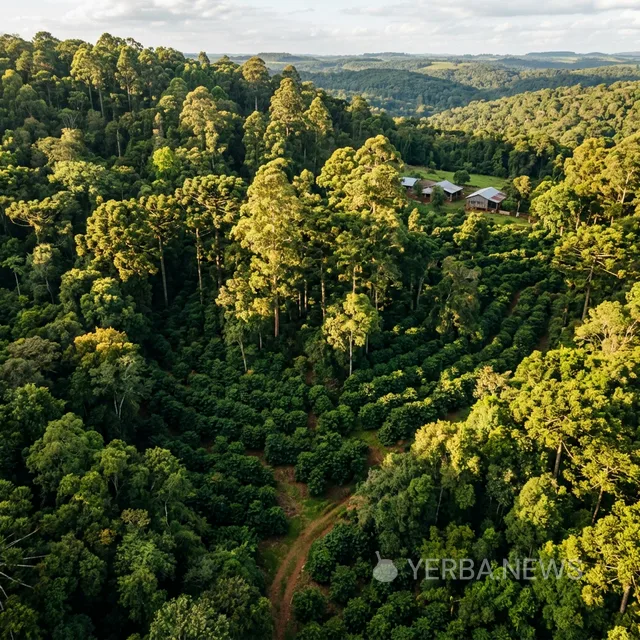
In the red-soil heartland of South America's mate country, a quiet revolution is underway. Farmers across the Paranaense region of Argentina and southern Brazil are abandoning decades of sun-plantation monoculture in favor of shade-grown yerba mate that mimics the species' natural understory habitat — and in doing so, they are rebuilding one of the planet's most devastated ecosystems.
The Atlantic Forest, which once stretched continuously from northern Argentina through Brazil to the Atlantic coast, has been reduced to roughly 7% of its original extent. Most of the destruction came from agricultural expansion, including, ironically, the conversion of diverse forest to intensive yerba mate monocultures. Now, as Food Tank reports, a growing network of producers is demonstrating that mate cultivation can be a vehicle for ecological restoration rather than degradation.
The Canopy Economy
Shade-grown mate requires integrating native tree species — lapacho, cedar, araucaria pine — into the plantation design, creating a multi-layered agroforestry system that provides habitat for birds, mammals, and insects while producing yerba mate of demonstrably superior quality. Slower growth under filtered sunlight produces leaves with higher concentrations of polyphenols and fewer bitter tannins, characteristics that command premium prices in specialty markets.

The environmental benefits extend beyond biodiversity. Shade-grown plantations demonstrate measurably better soil health, with higher organic matter content, improved water retention, and reduced erosion compared to sun-exposed monocultures. Root systems of the canopy trees reach deep aquifer layers, maintaining moisture levels during dry periods and reducing the need for irrigation — a critical advantage as climate change intensifies drought cycles across the region.
Market Signal
International buyers are increasingly willing to pay premiums of 40-60% for shade-grown, forest-friendly yerba mate, creating economic incentives that align conservation with profitability. Certification programs specifically designed for agroforestry mate are emerging, providing third-party verification that enables producers to access high-value export markets where sustainability credentials command real price premiums.
The shade-grown movement represents perhaps the most hopeful intersection of commerce and conservation in the global beverage industry. If the model scales — and the economic incentives increasingly suggest it will — yerba mate could become the rare agricultural commodity whose expansion actually improves ecosystem health rather than diminishing it.