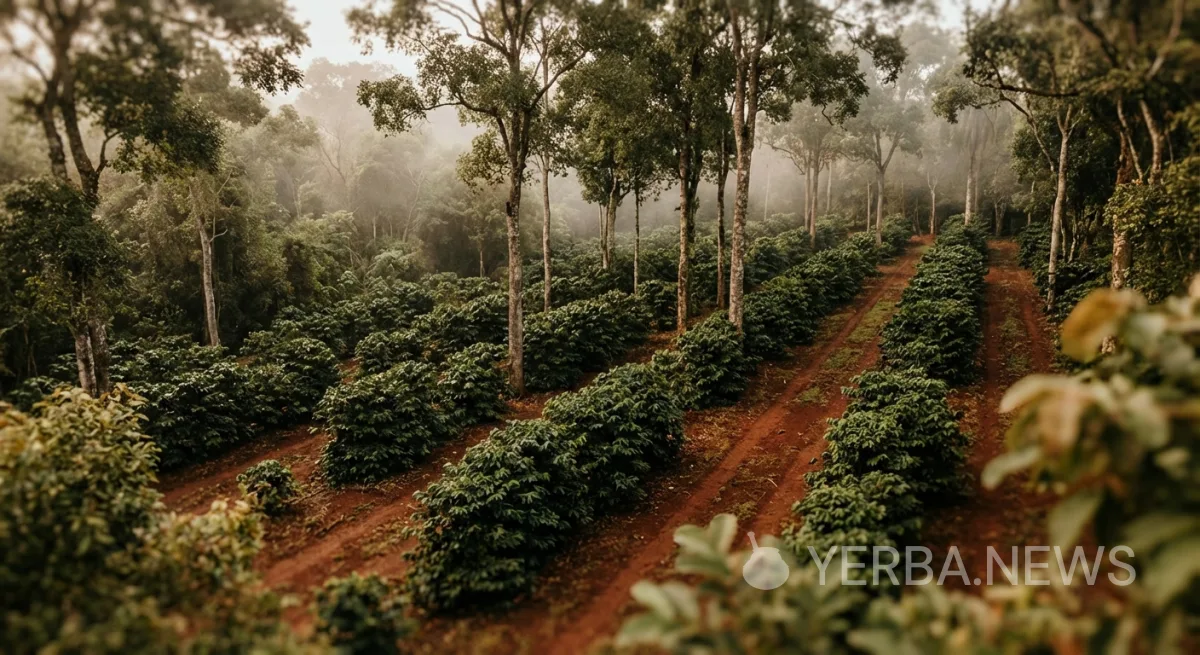
In the red-soil fields of Misiones province — the subtropical heart of Argentina's yerba mate industry — a transformation is underway that could redefine the environmental profile of one of South America's most traded agricultural commodities. Farmers who have grown yerba mate and cassava for generations are now measuring carbon footprints, integrating native trees into their plantations, and replacing chemical-intensive practices with soil-health strategies backed by government research institutions and international development banks.
The shift is not merely philosophical. It is data-driven, institution-backed, and increasingly measurable. Argentina's National Institute of Agricultural Technology (INTA) — the country's premier agricultural science body — is at the center of the movement, deploying field researchers, carbon measurement protocols, and cooperative partnerships across the northeastern provinces where 90 percent of the world's yerba mate is produced.
The Crecer Cooperando Initiative: 80 Farms, One Carbon Calculator
At the operational core of Argentina's regenerative yerba mate push is 'Crecer Cooperando' (Growing Cooperatively), a multi-year program jointly executed by INTA and Fundación Banco Credicoop with co-financing from BID Lab — the innovation laboratory of the Inter-American Development Bank (IDB). The initiative works directly with 80 yerba mate and cassava producers across Misiones and northern Corrientes provinces, providing technical assistance, soil analysis, and — critically — carbon footprint measurement as a decision-making tool [1].
The program represents a departure from conventional extension work. Rather than simply advocating better seeds or fertilizers, Crecer Cooperando treats environmental indicators as integral to farm economics. Field technicians work with each producer to quantify emissions generated during cultivation, processing, and transport — then use the data to identify specific interventions: reduced agrochemical inputs, improved crop rotation, composting, cover crops, and the strategic integration of native tree species within yerba mate plantations.
INTA's approach draws on more than a decade of research at its Cerro Azul Agricultural Experimental Station — the agency's primary hub for yerba mate science in Misiones — where researchers have studied the interaction between soil biology, shade canopy dynamics, and the carbon cycle in agroforestry systems.
The Carbon Math: What the Numbers Actually Say
The scientific case for regenerative yerba mate rests on two complementary bodies of evidence: life cycle assessments of the conventional value chain and carbon balance studies of alternative production systems.
In November 2024, a research team led by Diego Hernán Chifarelli published the most comprehensive Life Cycle Assessment (LCA) of yerba mate ever conducted. The study, published in MDPI's Sustainability journal, analyzed the full cradle-to-wholesale chain for one kilogram of commercial yerba mate produced in Misiones and transported 1,200 kilometers to Buenos Aires. Using ISO 14044 methodology and GaBi process modeling software, the team calculated total emissions of 1.24 kg CO2-equivalent per kilogram of finished product [2].
The finding that matters most for regenerative agriculture advocates is where those emissions originate. The cultivation phase — planting, maintaining, and harvesting the yerba mate bushes — contributes a negligible share of the total carbon footprint. The vast majority of emissions come from two downstream stages: industrial drying (the 'sapecado' and 'secanza' processes that use wood-fired ovens) and the long-distance road transport from Misiones to consumer markets in Buenos Aires and beyond.
This emission profile creates a paradox for regenerative farmers: the stage of production they directly control — cultivation — is already the cleanest part of the chain. The drying ovens and diesel trucks that move their leaves to market generate the environmental burden. Yet regenerative practices can still shift the equation at the farm level by turning yerba mate plantations from near-neutral carbon sources into active carbon sinks.
Carbon Matte: Measuring What Shade-Grown Mate Actually Absorbs
The tool designed to quantify that shift is called Carbon Matte — a specialized carbon calculator developed jointly by Solidaridad Network and Embrapa Florestas, Brazil's public agricultural research company specializing in forestry. The calculator measures the balance between carbon sequestration and greenhouse gas emissions across different yerba mate management systems, accounting for variables including tree density, shade levels, harvest intervals, plant spacing, and fertilization practices [1].
The results are striking. Shade-grown yerba mate systems — where Ilex paraguariensis bushes grow beneath the canopy of native tree species — consistently achieve a negative carbon balance, meaning they absorb more atmospheric CO2 than the total greenhouse gases they emit. The mechanism is straightforward: yerba mate sequesters carbon in its leaves, trunk, branches, and root system, while the surrounding native trees add their own sequestration capacity. Forest soils in these systems can absorb approximately 250 kg of CO2-equivalent of methane per hectare annually [1].
| Production System | Carbon Balance | Profitability | Biodiversity Impact |
|---|---|---|---|
| Full Sun (high density) | Positive (net emitter) | Highest short-term | Negative — reduces tree cover |
| Partial Shade (20-30% canopy) | Near neutral to slightly negative | Moderate | Moderate — maintains some habitat |
| Full Shade (agroforestry) | Negative (net absorber) | Lower per-area, growing premium market | Highest — integrates native species |
The tradeoff, however, is real. Full-sun cultivation with high plant density delivers the highest per-area profitability. The Solidaridad research explicitly flags this tension: converting to shade-grown systems reduces revenue unless offset by premium pricing or carbon credit compensation. The researchers recommend that policymakers develop 'practical policies, including additional compensation, to encourage yerba mate production using shaded cultivation techniques to capture higher levels of carbon.'
From Local Experiment to International Institutional Recognition
What distinguishes the current moment from earlier organic-farming advocacy is the institutional weight now being applied. In May 2025, the United Nations Food and Agriculture Organization (FAO) designated Brazil's traditional shaded yerba mate cultivation system in Paraná's Araucaria Forest as a Globally Important Agricultural Heritage System (GIAHS) — the second such recognition for Brazil. The designation recognizes the system's ancestral and agroecological practices as a model for integrating food crops, native fruits, and forest products while conserving an endangered biome [4].
While the GIAHS designation applies to Brazilian territory, its implications resonate across the border. Misiones province and the Brazilian state of Paraná share the same Atlantic Forest biome, the same Guaraní cultural heritage of yerba mate cultivation, and — increasingly — the same research networks. Argentina's INTA and Brazil's Embrapa have collaborated on agroforestry research for decades, and the regenerative practices validated by the GIAHS recognition are essentially identical to those now being deployed in Argentina's programs.
FONTAGRO and the Southern Cone Scale-Up
The regional dimension extends beyond bilateral research cooperation. FONTAGRO — the Regional Fund for Agricultural Technology, backed by the Inter-American Development Bank and the governments of Argentina, Bolivia, Chile, Colombia, Costa Rica, Dominican Republic, Ecuador, Honduras, Nicaragua, Panama, Paraguay, Peru, Spain, and Uruguay — is financing a multi-year public-private alliance to scale regenerative agriculture across the Southern Cone [3].
The project, formally titled 'Alianza público-privada para escalar la agricultura regenerativa en el Cono Sur,' brings together INTA (Argentina), IPTA (Paraguay's Institute of Agricultural Technology), and Bayer Crop Science. Its objectives explicitly include on-farm pilot sites, diversified crop rotations, cover crops, precision digital agriculture, and — mirroring the Crecer Cooperando approach — the systematic measurement of environmental indicators as a basis for agronomic decisions.
The FONTAGRO project plans to produce open-access databases, replicable methodologies, and technical publications — creating a transferable knowledge base that could accelerate adoption far beyond the initial pilot sites. The project has a 42-month execution period, meaning its outputs will continue to accumulate through at least late 2027.
Why Cassava Matters for the Regenerative Equation
The inclusion of cassava (mandioca) in INTA's regenerative programs is not incidental. Cassava is a staple crop of the northeastern Argentine economy, and its production systems face many of the same soil degradation challenges as yerba mate. Conventional cassava farming in red laterite soils depletes organic matter, compacts topsoil, and reduces water retention over successive planting cycles.
Regenerative practices applied to cassava — including no-till planting, diversified rotations with leguminous species, and integration with perennial crops like yerba mate — can rebuild soil carbon stocks while maintaining yields. INTA has been developing improved cassava varieties adapted to the specific conditions of Misiones, and the Crecer Cooperando program treats cassava and yerba mate as complementary components of a single regenerative farm system rather than separate crops with separate management strategies.
The Solidaridad Model: 150 Families, 1,000 Hectares, and Counting
On the Brazilian side of the border, Solidaridad Network's yerba mate program — active since 2019 and financed by Leão Foods and Beverages and Coca-Cola Brazil — offers a preview of what scaled regenerative yerba mate could look like. Over four years, the program has supported 150 farming families, impacted nearly 1,000 hectares of yerba mate cultivation, and contributed 300,000 seedlings. Average productivity reached 3.5 metric tonnes per hectare [1].
Critically, Solidaridad reports that increased use of agroforestry in program areas has helped restore previously deforested sections of farms and reconnected fragments of Brazil's Atlantic Forest — an ecological benefit that extends beyond carbon accounting. Farmers who use the Carbon Matte calculator and collaborate with technical specialists achieve economic gains while contributing to biodiversity conservation across one of the world's most endangered biomes.
What This Means for the Yerba Mate Industry
The convergence of Argentina's INTA programs, Brazil's Solidaridad work, FONTAGRO's Southern Cone alliance, and FAO's GIAHS recognition represents a critical mass of institutional support for regenerative yerba mate. For the first time, the industry has empirical carbon data, validated production models, international recognition, and cross-border research coordination simultaneously in play.
The commercial implications are also crystallizing. In early 2026, Yerba Madre — formerly Guayakí — achieved Regenerative Organic Certified (ROC) Gold status, the highest tier of certification available. Brands seeking sustainability credentials now have both the certification infrastructure and the agronomic data to back their claims. For consumer-facing companies in the rapidly growing RTD yerba mate segment, a verified regenerative supply chain could become a meaningful competitive differentiator.
The open question is whether carbon credit markets and premium pricing can close the profitability gap between full-sun and shade-grown systems quickly enough to drive adoption beyond early adopters. The Solidaridad researchers are blunt on this point: without policy intervention or market mechanisms that compensate farmers for carbon sequestration, the economic incentives still favor conventional full-sun production.
For now, the data pipeline is being built. The carbon is being counted. And in the red-soil fields of Misiones, a century-old crop is being reimagined — not through marketing rhetoric, but through soil samples, carbon calculators, and the unglamorous work of agronomic field research.