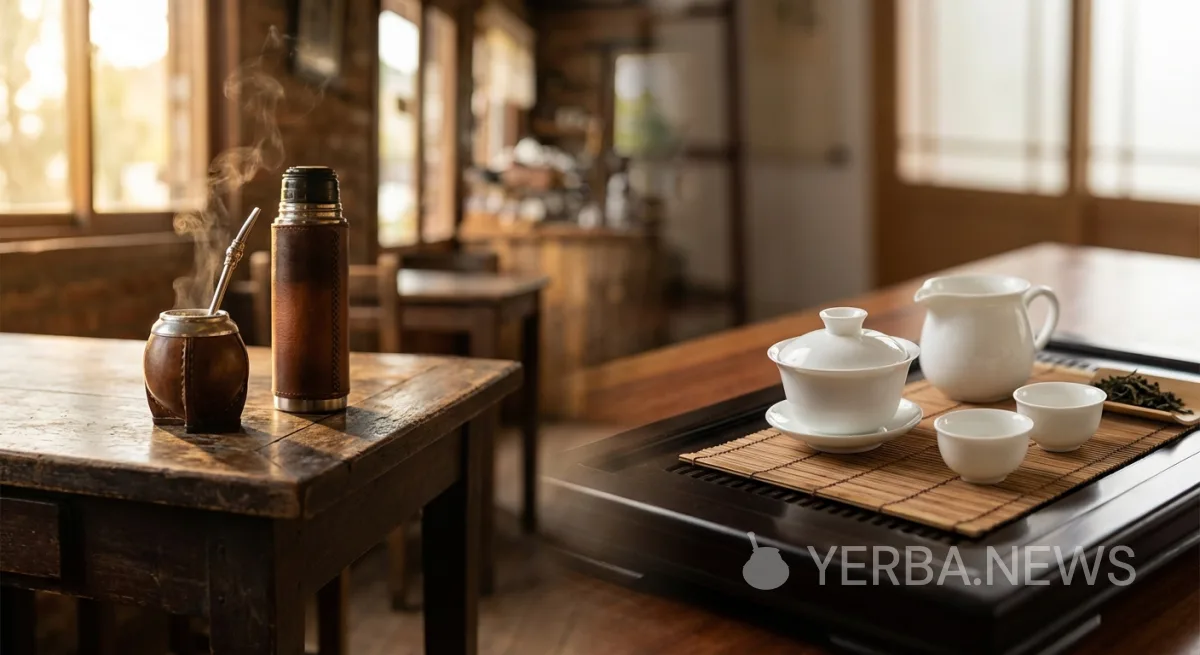
There is a saying — attributed to diplomats, journalists, and mate ambassadors alike — that Uruguay understands tea and China understands mate. It sounds like a riddle, and perhaps it is one: two countries separated by 19,000 kilometers, linked by no colonial history and no shared language, yet both organized around a single infused beverage that defines how their people greet each other, pass the time, and mark the rhythms of daily life. In Montevideo, the thermos and gourd are as universal as the smartphone. In Chengdu, the lidded gaiwan sits in the hands of retirees in every park. The parallel is not just poetic. It is structural, and in 2026 it is becoming political. [5]
Uruguay: The Republic of Mate
Uruguay consumes approximately 34.8 million kilograms of yerba mate per year — about 10 kilograms for every man, woman, and child in a country of 3.4 million. That figure, drawn from Uruguay's Chamber of Representatives, makes the country the world's undisputed leader in per-capita mate consumption, outpacing even Argentina, where the plant is actually grown at scale. According to the same parliamentary document, 85 percent of Uruguayans over the age of 15 drink mate at least once a week. For most, 'at least once' is a comical understatement: the thermos-and-gourd combination travels to the bus stop, the beach, the office, the hospital waiting room, and the football stadium. [1]
The irony is that Uruguay grows almost no yerba mate itself. The country's consumption depends overwhelmingly on imports from Brazil's southern states — Paraná, Santa Catarina, and Rio Grande do Sul — where the subtropical climate and acidic soils produce the Ilex paraguariensis plant in commercial quantities. Uruguay is, in economic terms, a pure consumer: a nation that has made another country's agricultural product the centerpiece of its own cultural identity. [1]
The cultural weight of mate in the Southern Cone was formalized in November 2018, when MERCOSUR designated the 'Cultural System of Yerba Mate' as part of its Cultural Heritage list, recognizing the beverage's role in the social fabric of Argentina, Brazil, Paraguay, and Uruguay. UNESCO's tentative list includes the 'Yerba Mate Cultural Landscape' as a cross-border nomination. Uruguay's own UNESCO Intangible Heritage entries are tango and candombe — mate's recognition operates at the regional, not national, level — but within Uruguay, no cultural practice commands wider daily participation. [4]
China: Where Tea Became Civilization
If Uruguay's mate habit is remarkable for its intensity, China's tea culture is remarkable for its depth. The State Council of China describes tea as one of the nation's 'seven essentials of daily life' — alongside firewood, rice, oil, salt, soy sauce, and vinegar — a classification that dates to the Song dynasty. The practice of brewing and sharing tea is documented from the Three Kingdoms and Jin periods, but it was Lu Yu's 'Classic of Tea' in the eighth-century Tang dynasty that codified what had been folk practice into a philosophical and aesthetic tradition that would spread across East Asia and, eventually, the world. [13]
In November 2022, UNESCO inscribed 'Traditional tea processing techniques and associated social practices in China' on its Representative List of the Intangible Cultural Heritage of Humanity. The inscription recognizes 44 nationally registered tea-related items spanning six categories — tea plantation management, picking, manual processing, drinking, sharing, and related rituals. When the Chinese government submitted its nomination, it emphasized that tea is not a museum piece but a 'living social practice,' ubiquitous in homes, workplaces, teahouses, restaurants, and temples. [2] [13]
The scale is difficult to overstate. China produced 3.34 million tonnes of tea in 2022 — nearly 50 percent of global output — up from 1.92 million tonnes in 2013, according to FAO data. The China Tea Marketing Association reported that China exported 374,100 tonnes of tea in 2024, worth US$1.419 billion. Total tea trade volume (import and export combined) reached 428,100 tonnes that year, up 5.3 percent year on year. And the ambition is expanding: a February 2026 strategy document, covered by China Daily, sets a government target of building a 1.5-trillion-yuan (approximately US$210 billion) full tea-industry chain by 2030 — a figure that includes cultivation, processing, distribution, tourism, and cultural products. [3] [4] [9]
The Structural Parallel
At first glance, comparing mate and tea seems like comparing a bicycle to a bullet train. China's tea industry is an economic superpower. Uruguay's mate culture is, by comparison, a household ritual attached to a modest import ledger. But the comparison that CGTN, diplomats, and scholars keep reaching for is not economic. It is behavioral.
Both beverages are communal. Mate is shared from a single gourd and bombilla, passed hand to hand in a circle governed by unspoken rules: the cebador (server) drinks first, water temperature is controlled precisely, and saying 'thank you' signals you are done. Chinese tea service — particularly gongfu cha — involves similar ritualized choreography: the host washes the leaves, discards the first infusion, pours for guests before themselves, and uses specific gestures to convey respect. In both traditions, the drink is secondary to the act of sharing it.
Both are daily, not occasional. Where coffee cultures in the West tend toward the transactional — a latte grabbed in motion — both mate and tea are structured around pauses. The Uruguayan mate break is not a five-minute caffeine hit; it is a slow, multi-refill session that can last an hour. The Chinese teahouse visit serves the same temporal function. As Julia Sarreal's scholarship on mate notes, the beverage's social role has remained remarkably stable from the colonial period to the present: it 'has been a daily companion of the common person as well as the elite,' a marker of egalitarianism in a region otherwise defined by inequality. [14]
| Dimension | Yerba Mate (Uruguay) | Tea (China) |
|---|---|---|
| Daily participation | 85% of adults consume weekly | Ubiquitous; one of "seven essentials" |
| Utensils | Gourd (mate) + metal straw (bombilla) | Gaiwan, Yixing teapot, gongfu set |
| Serving ritual | Cebador serves, circle passes gourd | Host serves guests first, multiple infusions |
| UNESCO recognition | MERCOSUR Cultural Heritage (2018) | UNESCO Intangible Heritage (2022) |
| Production | Uruguay imports 100% (from Brazil) | China produces 50% of world supply |
| Per-capita consumption | ~10 kg/year | ~1.9 kg/year (of all teas) |
| Key social function | Egalitarian bonding, anti-hierarchical | Hospitality, respect, meditation |
When Mate Met the Middle Kingdom
For most of its modern history, yerba mate has been invisible in China. The plant does not grow there, the flavor profile — bitter, grassy, vegetal — departs sharply from the floral and roasted notes of Chinese teas, and no historical trade route connected the Southern Cone to East Asia. That started to change in the 2010s, as Argentine trade missions, led partly by the Instituto Nacional de la Yerba Mate (INYM), began targeting the Chinese market alongside traditional Middle Eastern buyers.
The numbers remain modest. World Bank WITS data shows that China imported US$473,470 worth of mate (HS 0903) in 2023 — 117,578 kilograms — overwhelmingly sourced from Argentina and Brazil. For comparison, Argentina's global mate exports hit a record 44 million kilograms that same year. China, in other words, accounts for roughly 0.27 percent of the world mate trade. It is a rounding error in export ledgers and a footnote in INYM reports. [7] [8]
But raw trade volumes are the wrong metric for what is happening on the ground. In December 2023, China's National Health Commission made a regulatory move that went largely unnoticed outside the food-safety world: it approved yerba mate leaf (Ilex paraguariensis) as a 'new food raw material.' The NHC's interpretation noted that mate leaf contains polyphenols, flavonoids, and saponins — compounds familiar to Chinese consumers from their own tea vocabulary — while cautioning that infants, pregnant women, and breastfeeding women should avoid it pending further safety data. A 2025 review in LWT – Food Science and Technology observed that the approval opened 'broader application prospects beyond infusion' in the Chinese market.
That regulatory green light has coincided with tangible retail activity. The Singapore-based brand MATE MATE launched a sparkling yerba mate energy drink in China in 2021, positioning it as a healthier alternative to synthetic energy drinks. Argentina's Taragüi — the country's best-selling yerba mate brand — now lists 17 sales points and e-commerce channels in China, including a dedicated Tmall flagship store and a China-facing website (taragui.cn) with full Mandarin-language marketing.
The most telling signal, however, may be the specialty-shop phenomenon. In Shanghai, a café called FIVEMATE has fused Brazilian mate culture with Chinese milk-tea aesthetics, offering locally adapted mate drinks designed to bridge the gap between bitter gourd tradition and the sweet, creamy textures that dominate China's massive new-tea-drink market. Industry outlet 36Kr reported that similar mate specialty shops were gaining traction in Guangzhou, while chains such as Cotti have tested mate-based products, marketing the drink as a 'light pick-me-up' and coffee alternative — language calibrated for a generation of Chinese consumers already spending billions on bubble tea and specialty coffee.
The Diplomatic Accelerant
The beverage exchange is not happening in a political vacuum. In November 2023, China and Uruguay elevated their bilateral relationship to a 'Comprehensive Strategic Partnership' — the highest tier in Beijing's diplomatic taxonomy, signaling deep political trust and long-term economic integration. Uruguay XXI, the country's trade and investment promotion agency, reported that China–Uruguay bilateral trade grew 66 percent between 2020 and 2024, reaching approximately US$5.5 billion. Uruguay's exports to China are dominated by soybeans, cellulose, beef, and wool — commodity agriculture, not mate — but the cultural dimension of the relationship is receiving unprecedented attention. [6] [11]
In February 2026, Uruguayan President Yamandú Orsi led an official mission to China aimed at deepening ties, expanding market access, and attracting investment. More than 80 Uruguayan companies participated in a Uruguay–China Trade and Investment Forum in Beijing. During the visit, Uruguay XXI signed a Memorandum of Understanding with CCPIT (the China Council for the Promotion of International Trade) to deepen bilateral trade and investment cooperation. While no mate-specific trade agreement emerged from the mission, the cultural signaling was unmistakable. [15] [16] [11]
In December 2024, Uruguay's consul in China used a Macao cultural program to formally introduce yerba mate to Chinese audiences and publicly stated that he was 'glad to see it becoming more popular in China.' The following February, CGTN — China's international state broadcaster — aired a feature titled 'Mate and tea: a dialogue beyond distance,' explicitly framing the two beverages as a bridge in China–Uruguay cultural relations. At the 7th China International Import Expo (CIIE) in November 2024, Argentine yerba mate was among the Latin American products showcased as gaining 'direct access to the Chinese market.' [5] [10] [12]
The INYM Playbook: From Middle East to Far East
Argentina's INYM — the government body that regulates and promotes yerba mate — has historically focused its export promotion on the Middle East, particularly Syria and Lebanon, where a century-old diaspora connection sustains significant demand. But INYM communications increasingly position Asian markets as the next frontier. The institute's 2024 Middle East promotion materials note that the region can 'open doors to Asian markets including India, China, Japan, Turkey, and the UAE, where mate consumption is still incipient.' [8]
Concrete steps are underway. INYM has backed mate introductions in Thailand with Argentine embassy support and celebrated the opening of the first dedicated yerba mate café in Vietnam. An INYM report on the Vietnam launch quoted Argentine diplomats saying that mate 'has reached India' and that 'work is underway in China.' The language is careful — no one is claiming a breakthrough — but the institutional orientation has shifted. The question is no longer whether yerba mate can find consumers outside the Southern Cone and the Middle East, but how fast. [8]
Two Rituals, One Logic
The deepest resonance between mate and tea is neither economic nor diplomatic. It is temporal. Both drinks resist the acceleration that defines modern consumption. You cannot rush a gongfu tea session any more than you can rush a mate round. The host controls the pace. The guest submits to it. The result is a form of enforced presence — a social technology that predates mindfulness apps by centuries and functions, in practice, far more reliably.
When Uruguay's diplomats share mate in Beijing reception halls, and when Shanghai baristas redesign the gourd into a takeaway cup, they are not merely exchanging products. They are testing whether two rituals built on the same logic — slow down, sit together, share what is in the cup — can recognize each other across the gap of language, latitude, and history. The early evidence, from trade data to teahouse menus, suggests that they can.
The numbers will remain small for years. US$473,000 in annual mate imports does not register on China's US$2.6 trillion trade balance. But cultural influence has never moved on the same timeline as container shipping. Tea itself took centuries to travel from Yunnan to London. Mate, now backed by regulatory approval, diplomatic attention, and a generation of Chinese consumers already conditioned to experiment with novel infusions, is beginning its own journey east. This time, it carries a thermos.