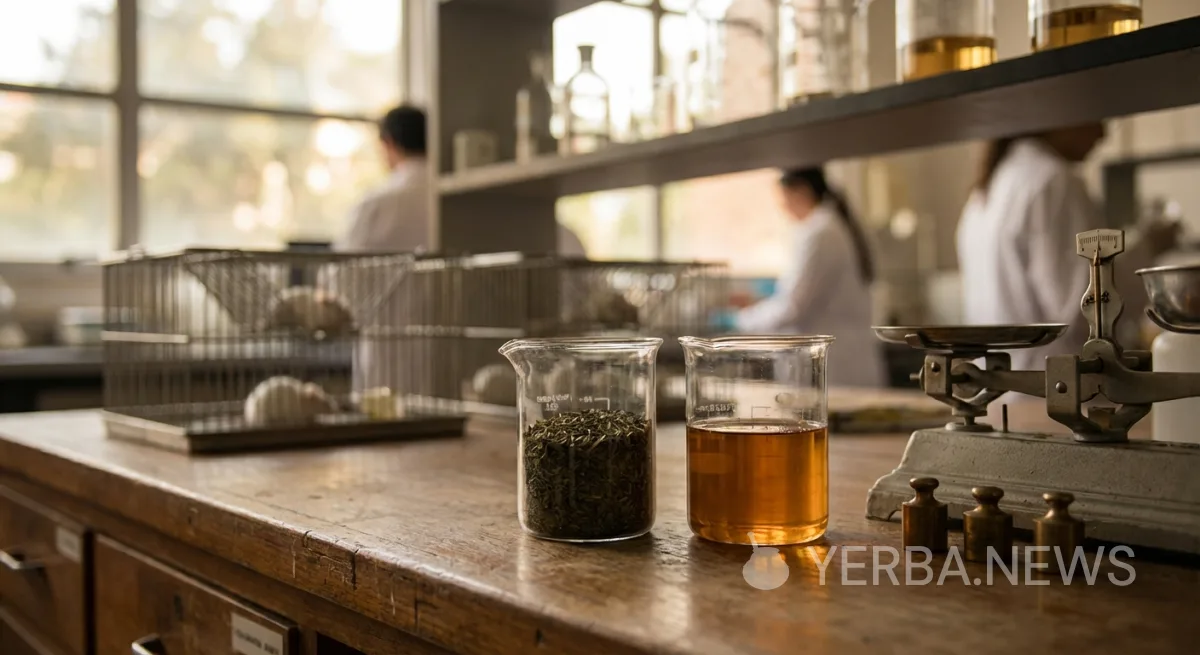
A team of South Korean researchers from Wonkwang University has published evidence that yerba mate (Ilex paraguariensis) extract possesses significant anti-obesity and anti-diabetic properties. The peer-reviewed study, published in Laboratory Animal Research in March 2012, tested the effects of yerba mate extract on mice fed a high-fat diet and found dose-dependent improvements across multiple metabolic markers [1].
Study Design: Three Dosages Tested Over Four Weeks
The researchers, led by Young-Rye Kang and Hong-Geun Oh, used male C57BL/6J mice — a widely-used model for diet-induced obesity research. After acclimatizing for one week, the mice were fed a 60% fat calorie diet for six weeks to induce obesity, then divided into five groups of ten animals each: a normal diet control group, a high-fat diet (HFD) control group, and three HFD groups receiving yerba mate extract at doses of 0.5, 1.0, and 2.0 grams per kilogram of body weight per day [1].
The yerba mate used in the study was collected in Argentina and processed into an aqueous extract. One kilogram of dried mate was extracted three times with 10 liters of distilled water at 100°C for two hours, yielding 200 grams of extract powder. The extract was dissolved in purified water and administered daily via intragastric gavage for four weeks [1].
Key Findings: Weight Loss and Reduced Food Intake
The study produced several notable findings. Mice receiving yerba mate showed significantly less body weight gain compared to the untreated HFD control group, with the effect being dose-dependent — higher doses produced greater reductions. Importantly, the mate-treated groups also showed decreased food and water intake, suggesting that yerba mate may influence appetite regulation [1].
The researchers observed that yerba mate treatment resulted in higher energy expenditure, likely from an elevated basal metabolism in treated mice. This dual mechanism — reduced caloric intake combined with increased energy expenditure — may explain the significant anti-obesity effects observed across all three dosage groups [1].
Fat Tissue Reduction Across All Fat Depots
One of the study's most striking findings concerned visceral fat accumulation. The weights of three types of abdominal fat tissue — epididymal, retroperitoneal, and peri-renal fat — were all significantly reduced in yerba mate-treated groups compared to the HFD control. Histological analysis further confirmed that individual adipocyte (fat cell) size was smaller in the mate-treated groups, indicating that the extract inhibited both the growth and the lipid accumulation within fat cells [1].
| Parameter | Normal | HFD | Mate 0.5 | Mate 1.0 | Mate 2.0 |
|---|---|---|---|---|---|
| Body weight | Baseline | Increased | Decreased | Decreased | Most decreased |
| Food intake | Normal | Elevated | Decreased | Decreased | Most decreased |
| Blood glucose | Normal | Elevated | Lowered | Lowered | Most lowered |
| Epididymal fat | Normal | Increased | Reduced | Reduced | Most reduced |
| Retroperitoneal fat | Normal | Increased | Reduced | Reduced | Most reduced |
| Peri-renal fat | Normal | Increased | Reduced | Reduced | Most reduced |
| Adipocyte size | Normal | Enlarged | Smaller | Smaller | Smallest |
Blood Lipids and Glucose: A Dose-Dependent Response
Beyond weight and fat reduction, the study measured several blood biomarkers critical to metabolic health. After four weeks of yerba mate administration, the treated groups showed significantly lower serum triglyceride and total cholesterol concentrations compared to the HFD control group. Blood glucose levels were also reduced, supporting the anti-diabetic potential of yerba mate [1].
Leptin levels — a hormone produced by fat cells that regulates appetite and energy balance — were markedly elevated in the HFD control group compared to normal-diet mice, consistent with the obesity-induced leptin resistance commonly seen in metabolic syndrome. Treatment with yerba mate extract significantly reduced serum leptin concentrations, suggesting a recovery of leptin sensitivity [1].
Liver Protection: Reduced Hepatic Steatosis
The high-fat diet induced hepatic steatosis (fatty liver) in the control group, a condition closely associated with obesity and metabolic syndrome. Histological examination of liver tissue revealed that yerba mate treatment reduced steatosis in a dose-dependent manner, with the highest dose (2.0 g/kg) showing the most pronounced improvement. Notably, the researchers did not observe hepatocyte ballooning or inflammatory cell infiltration in any group, indicating that the liver damage remained in early stages [1].
The Biochemistry Behind the Effect
The researchers attributed the observed effects to several classes of bioactive compounds found in yerba mate. Chlorogenic acid, the primary polyphenol in the plant, is thought to modulate the activity of glucose-6-phosphatase, an enzyme involved in glucose metabolism, and to reduce cardiovascular disease risk by decreasing LDL oxidation [1]. Methylxanthines, including caffeine and theobromine, contribute to the central nervous system-stimulant properties and may increase basal metabolism. Saponins, another class of compounds in yerba mate, have been reported to interfere with cholesterol metabolism, which could partially explain the cholesterol-lowering effects observed in the study [1].
- Chlorogenic acid — modulates glucose-6-phosphatase, reduces LDL oxidation
- Methylxanthines (caffeine, theobromine) — stimulate central nervous system, increase energy expenditure
- Saponins — interfere with cholesterol metabolism
- Flavonoids (quercetin, kaempferol, rutin) — antioxidant activity
- Caffeic acid and dicaffeoylquinic acid derivatives — additional antioxidant properties
Limitations and Context
As with any animal study, direct extrapolation to humans requires caution. The C57BL/6J mouse model, while well-established for diet-induced obesity research, does not perfectly replicate human metabolism. The four-week treatment period was relatively short, and longer studies would be needed to assess sustained effects and potential side effects. The study was conducted at Wonkwang University in Iksan, South Korea, with funding from the MICE project of Jeju Island, Ministry of Knowledge Economy [1].
The study's authors concluded that "Yerba Mate extract has potent anti-obesity activity in vivo" and that "Yerba Mate treatment has a modulatory effect on glucose levels related to obesity" [1]. They suggested that the synergistic action of multiple bioactive compounds in yerba mate may be responsible for the broad spectrum of metabolic improvements observed.
Broader Significance
This study adds to a growing body of scientific literature investigating the therapeutic potential of Ilex paraguariensis. While yerba mate has been consumed for centuries across South America and is one of the most widely-used herbal teas worldwide, its pharmacological properties have only recently attracted systematic scientific attention. The authors note that yerba mate may offer advantages over other weight-loss herbal medicines and supplements, which have been clinically linked to adverse events [1].
The research is particularly relevant as obesity and type 2 diabetes continue to rise globally. According to the study, yerba mate's ability to simultaneously target multiple metabolic pathways — appetite, energy expenditure, lipid metabolism, glucose regulation, and fat cell development — makes it a compelling candidate for further clinical investigation in human populations.