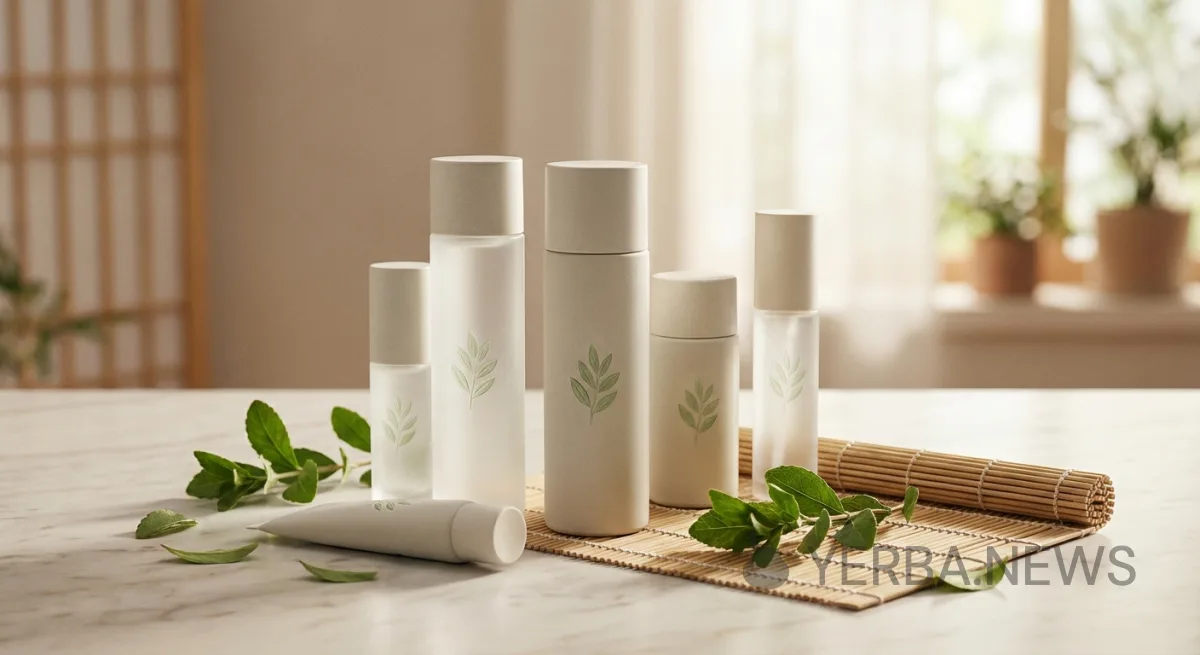
When yerba mate entered the Japanese market, it arrived through the door that most Western observers would have expected: the beverage aisle. But the more consequential development may be happening in an entirely different section of the store. According to data compiled by Market Reports World, Japan launched 13 new cosmetic SKUs containing Ilex paraguariensis extracts in 2023 — a product development velocity that suggests Japanese formulators see yerba mate not merely as a drink ingredient but as a versatile botanical with applications across the personal-care industry.
Why Yerba Mate in Skincare?
The cosmetic chemistry rationale is straightforward and well-supported. Yerba mate leaf extracts contain a potent cocktail of compounds with established dermatological relevance: chlorogenic acid and its derivatives (powerful antioxidants that neutralize reactive oxygen species in skin cells), caffeine (a vasoconstrictor that reduces puffiness and is a proven active ingredient in anti-cellulite formulations), and a suite of flavonoids and polyphenols that exhibit anti-inflammatory and photoprotective properties. These compounds have been individually validated in dermatological research; yerba mate's value proposition is that it delivers all of them in a single botanical extract, potentially simplifying formulation and appealing to the clean-beauty movement's preference for recognizable, plant-derived ingredients.
Product Categories and Applications
The 13 new Japanese SKUs span multiple product categories. Eye creams and serums leverage caffeine's puffiness-reducing effect. Body firming lotions use yerba mate's caffeine and polyphenol combination for anti-cellulite claims. Face moisturizers and essences highlight the antioxidant properties of chlorogenic acid for anti-aging positioning. And at least two products incorporate yerba mate extract into hair-care formulations, where its stimulant and anti-inflammatory properties are marketed as promoting scalp health and hair follicle vitality.
Japan as a Bellwether Market
Japan's cosmetics industry is widely regarded as a global bellwether for ingredient innovation. Products that gain traction in the Japanese market — where consumers are notoriously quality-conscious and ingredient-literate — tend to diffuse to South Korea, then to the broader Asian beauty markets, and eventually to Europe and North America. If yerba mate establishes itself as a recognized ingredient in Japanese skincare, the implications for global demand could be substantial: the cosmetic-grade extract market would add an entirely new demand channel for Ilex paraguariensis, supplementing the beverage market and potentially commanding premium prices for standardized, pharmaceutical-grade extracts.
From Gourd to Vanity Table
The Japanese cosmetics story is part of a broader pattern of yerba mate diversification. Dietary supplement capsules and powders, functional food ingredients, and now cosmetics are collectively expanding the plant's addressable market beyond its historical identity as a hot beverage. For South American producers, this diversification represents both an opportunity and a strategic imperative: as the traditional mate-drinking market in Argentina approaches saturation and domestic consumption faces pressure from inflation, new applications in new geographies offer a pathway to sustained demand growth. Japan's 13 new SKUs may be a small number in absolute terms, but as a leading indicator of where the global ingredient market is heading, they are significant.