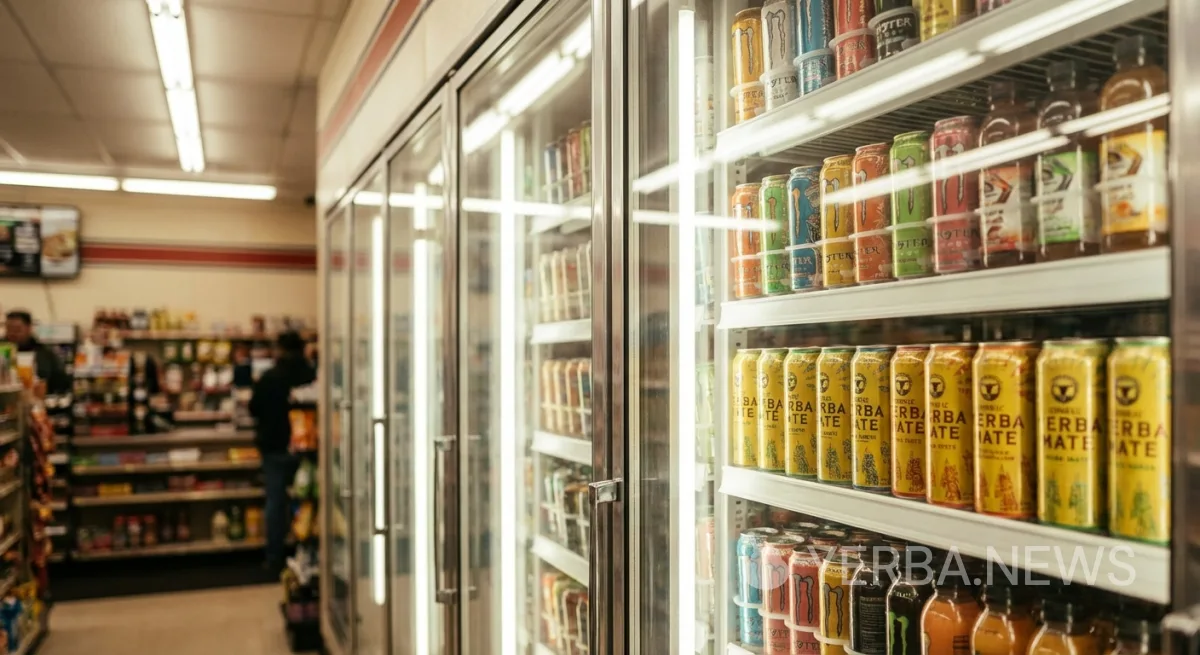
When Drink Weird launched its yerba mate line, the brand's strategic thesis was deliberately contrarian: instead of following the established playbook of entering through natural grocery and specialty retail (the path taken by Guayakí, Mateína, and most other independents), Drink Weird targeted convenience stores first. The bet was that yerba mate's future in the United States depends not on the 7% of consumers who shop at Whole Foods but on the 93% who buy beverages from gas stations, convenience chains, and mass-market grocery.
From 6,000 to 10,000 Doors
As reported by BevNET in March 2024, Drink Weird had already placed product in approximately 6,000 retail locations nationwide, with roughly 4,000 of those being convenience stores — an unusually high C-store concentration for a yerba mate brand. By the end of 2025 and into early 2026, the brand's expansion had accelerated dramatically, with its own news feed documenting a series of distribution wins that pushed the total past 10,000 doors.
- Key distribution milestones (verified from drinkweird.com):
- July 2025: Available at select HEB stores in Texas
- September 2025: Expanded to more Costco warehouses in Northern California and Nevada
- December 2025: Launched in Asheville, NC through Budweiser of Asheville
- January 2026: Available at all Jacksons Food Stores
- January 2026: Distribution with Bueno Beverage (Anheuser-Busch) in California's Central Valley
- January 2026: Rolled out to all Fred Meyer stores
- February 2026: Expanded Nevada distribution with Nevada Beverage (Anheuser-Busch)
- February 2026: Available at Lazy Acres Natural Market
The AB Distributor Strategy
The most strategically significant element of Drink Weird's expansion is its partnerships with Anheuser-Busch distributors — specifically Nevada Beverage and Bueno Beverage. The AB distribution network is the most extensive alcohol and beverage distribution system in the United States, and its infrastructure (refrigerated trucks, established relationships with C-store and grocery buyers, route-level delivery) gives brands that gain access to it a logistics capability that would take years and tens of millions of dollars to build independently. For a yerba mate brand, AB distribution is a force multiplier: it means your cans arrive cold, on time, and with the same delivery reliability as Budweiser.
What This Means for the Category
Drink Weird's convenience-first strategy is a direct challenge to the assumption that yerba mate is a 'natural channel' product that must establish credibility in Whole Foods before crossing over to mainstream retail. If Drink Weird demonstrates that yerba mate can achieve velocity (sales per point of distribution) in convenience stores comparable to established energy drink brands, it will validate a distribution model that other yerba mate brands — and their investors — will seek to replicate. The brand's expansion from 6,000 to 10,000 doors in roughly 18 months, powered by AB distributor partnerships, suggests that the convenience channel is not merely receptive to yerba mate but actively absorbing it.