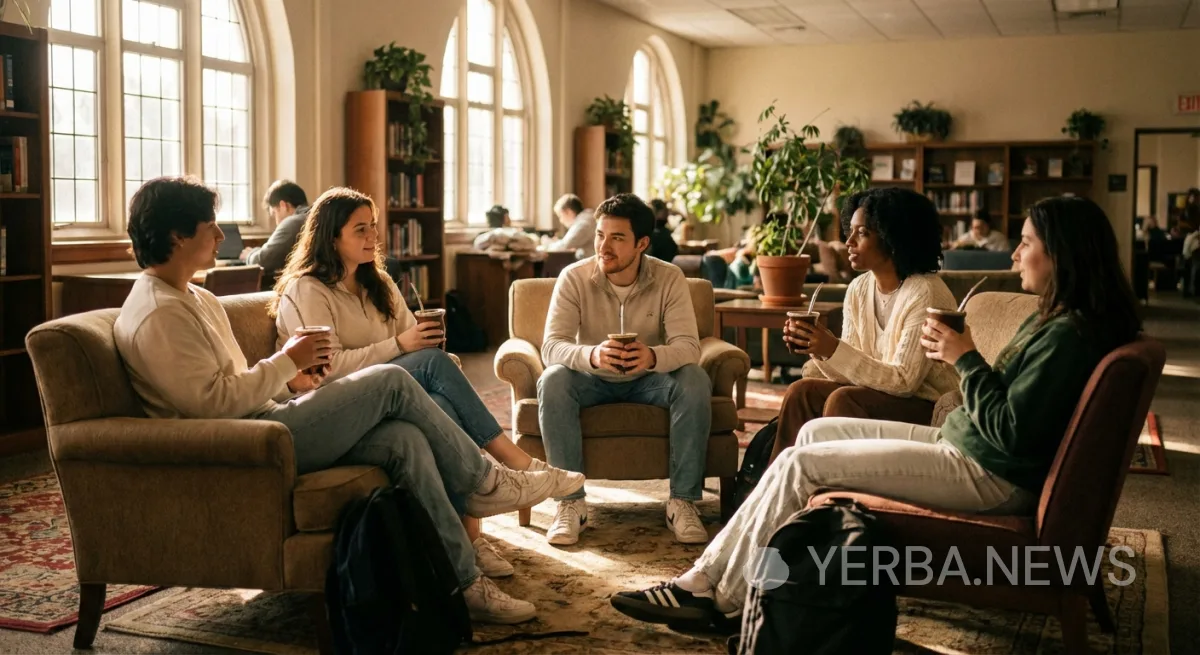
Every Tuesday evening during Clubs Night at Brigham Young University's Wilkinson Center, a circle forms around a familiar ritual: hot water poured into gourds, metal bombillas passed hand to hand, and conversations that bridge continents. The BYU Yerba Mate Club, one of the university's more distinctive student organizations, has carved out a weekly space for sharing South America's most communal beverage — at a campus where the relationship between students and caffeinated drinks is, by any measure, unusually complicated.
A Caffeine Question at a Unique University
BYU is operated by The Church of Jesus Christ of Latter-day Saints, which maintains the Word of Wisdom — a health code that prohibits coffee and tea. The theological interpretation of whether yerba mate falls within these restrictions has long been debated among church members: the plant is neither Coffea arabica nor Camellia sinensis, yet it contains caffeine. In 2012, the church clarified that the Word of Wisdom does not specifically ban caffeine, a statement that opened conceptual space for mate consumption. The Yerba Mate Club occupies this space thoughtfully, positioning itself as a cultural rather than dietary organization.
The Returned Missionary Connection
BYU's student body includes one of the highest concentrations of returned Latter-day Saint missionaries of any university in the world. Thousands of students have served two-year missions in Argentina, Uruguay, Paraguay, Brazil, and Chile — the global heartland of mate culture. For these returned missionaries, the gourd is not merely a beverage container but a powerful trigger of sensory memory: the taste of Patagonian mornings, the warmth of a host family's kitchen in Corrientes, the sound of a language they once spoke daily. The club provides a structured way to maintain these connections and transmit them to students who have no direct South American experience.
Cultural Transmission in Practice
The club's format mirrors the mate ritual itself: circular, egalitarian, and unhurried. Members bring their own gourds or borrow from the club's communal supply. International students from Latin America serve as informal cultural guides, teaching newcomers the etiquette of the ronda — don't stir the bombilla, don't say 'thank you' unless you're done, drink the entire serving before passing the gourd back to the cebador. These seemingly minor rules encode deeper cultural values about patience, trust, and shared experience that transcend the beverage itself.
The BYU Yerba Mate Club operates alongside other Latin American cultural organizations on campus, including the Student Association for Latin American Studies (SALAS), Latinos Unidos, and the Luso-Brazilian Association. Together, these groups form a network that keeps South American cultures visible in a predominantly English-speaking, North American campus environment — one gourd at a time.