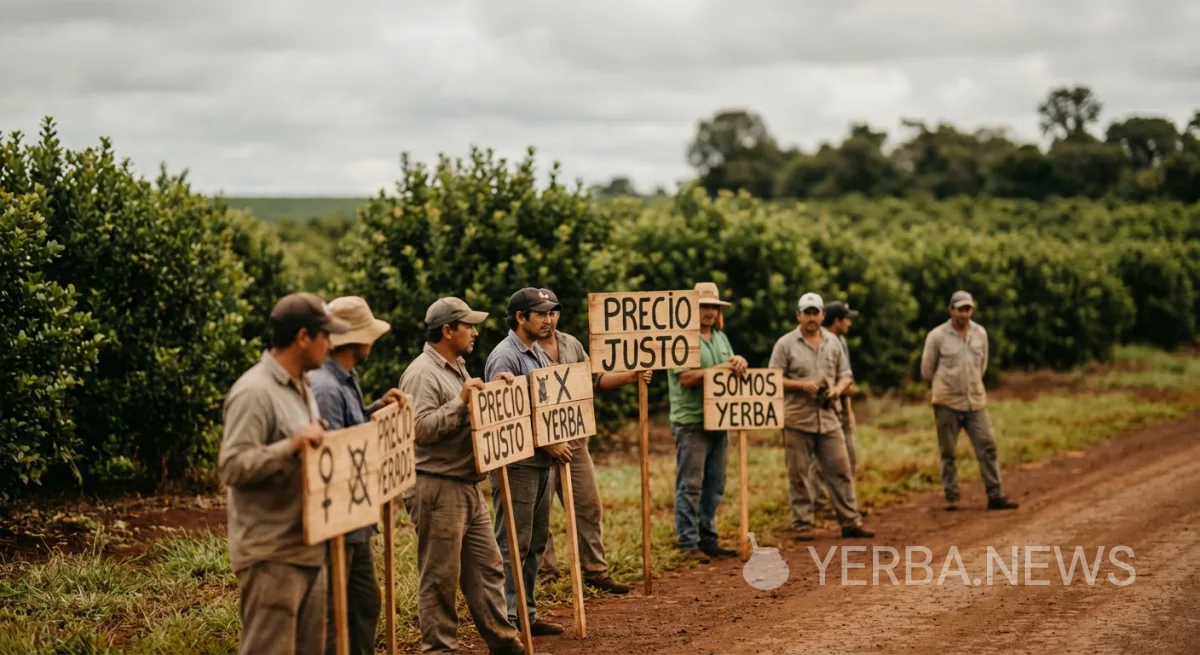
President Javier Milei's sweeping deregulation agenda has reached one of Argentina's most culturally significant agricultural sectors, with consequences that are reshaping the economics of yerba mate production across the nation's northeastern provinces. The elimination of price-setting powers held by the Instituto Nacional de la Yerba Mate (INYM) — Argentina's national yerba mate regulatory body — has set off a chain reaction that industry observers describe as the most severe crisis the sector has faced in two decades.
The Price Collapse
In early 2025, yerba mate farmers in Misiones and Corrientes provinces reported receiving as little as 180 pesos per kilogram of green leaf (hoja verde), a sharp decline from approximately 250 pesos per kilogram at the end of 2023. Independent agricultural economists estimate the true cost of production at around 356 pesos per kilogram, meaning that producers are now operating at a loss of nearly 50% on every kilogram harvested. The price collapse follows the Milei administration's broader economic 'shock therapy' program, which has systematically dismantled state intervention mechanisms across multiple sectors.
An Indefinite Strike
In December 2024, over 13,500 yerba mate producers launched an indefinite strike, demanding prices that cover their production costs. The work stoppage — which threatens to extend through March 2025 — represents the largest coordinated action by Argentine yerba mate farmers in recent memory. The province of Misiones, which accounts for approximately 90% of national yerba mate production, has formally opposed the deregulation measures and filed legal appeals in federal court, arguing the policy disproportionately harms smallholders who lack the scale economies of large agroindustrial operations.
Record Harvest, Record Pain
The price crisis is compounded by a paradox of abundance. Argentina recorded a historic harvest of approximately 1.1 million metric tons of yerba mate in 2024 — a 27% increase over 2023 levels and the highest volume since 2019, according to INYM data. Domestic consumption, however, has not kept pace, contributing to an oversupply that further depresses prices. Some farmers have responded by reducing their 2025 planting by as much as 20%, a decision that could create supply shortages in subsequent years.
Meanwhile, consumer prices at retail remain relatively elevated, with a kilogram of packaged yerba mate selling for between 4,000 and 5,000 pesos in Argentine supermarkets. The growing disparity between what farmers receive and what consumers pay has become a focal point of political debate, raising questions about the distribution of value within the supply chain. Despite existing stock levels estimated to cover 18 months of consumption, industry analysts warn that the structural damage to the smallholder sector may prove difficult to reverse once market dynamics stabilize.