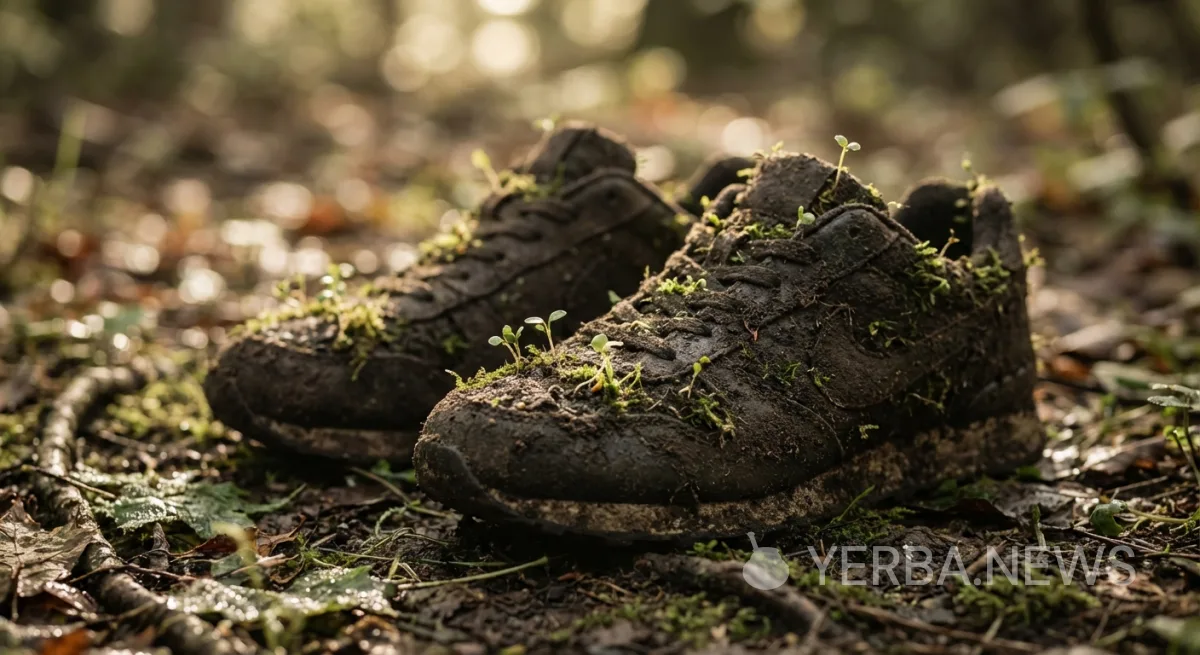
In one of the more conceptually audacious brand collaborations in recent memory, Yerba Madre — the yerba mate company formerly known as Guayakí — has partnered with Basura, a New York City-based design studio whose name translates to 'trash' in Spanish, to produce a pair of sneakers made entirely from dirt. The 'Dirt Shoes,' reported extensively by Dezeen, Designboom, DOMUS, It's Nice That, Yanko Design, and Design Indaba in mid-2025, are not a commercial product. They are a conceptual object designed to communicate a single idea: everything Yerba Madre makes is intended to give back to the earth.
The Material Composition
The Dirt Shoes are fabricated from a marbled mixture of soil, organic fibers, and Acacia gum — a naturally derived tree sap that acts as the binding agent holding the shoe together in its wearable form. Embedded along the sole are wildflower seeds, positioned so that as the shoe disintegrates during use, the seeds are deposited into the ground where the wearer walks. The production process combines 3D-printed molds — which provide the shoe's sneaker silhouette — with hand-crafting techniques that compress the soil mixture into the final form. The result is an object that is recognizably a shoe in shape and proportion but is unmistakably soil in texture, color, and fragility.
Built to Disappear
The shoes are designed to last only a few minutes when actually worn outdoors. Walking in them causes the compacted soil to crack, separate, and scatter — a planned failure mode that is the entire point. As the shoe breaks apart, it disperses its wildflower seeds across whatever surface the wearer has crossed, leaving behind a trail of future flowers rather than a trail of microplastics. Even the packaging is designed to vanish: it is made from starch foam that dissolves completely in water.
Rajeev Basu, founder of Basura, described the objective as creating 'a surprising and stylish sneaker that is literally made of dirt' — a deliberate inversion of the fashion industry's typical value proposition, which is to produce objects that resist degradation for as long as possible. The Dirt Shoes propose the opposite: that the most meaningful product is one that improves the world by ceasing to exist.
Brand Strategy as Environmental Storytelling
The Dirt Shoes are not available for purchase and were never intended to be. Their function is communicative, not commercial: they are a physical embodiment of Yerba Madre's regenerative brand identity, designed to generate media coverage (which they have, across at least seven major international design publications) and to associate the brand with circularity at its most literal and most radical. For a company that has just achieved the world's first Regenerative Organic Certified Gold designation for a yerba mate product, the shoes extend the regeneration narrative from agriculture into design — arguing that the same principles that govern how Yerba Madre grows its leaves should govern how it communicates its values.
Whether the Dirt Shoes constitute genuine environmental contribution or performative marketing is a legitimate question. The answer may be both. The shoes themselves do not offset a single gram of carbon. But they have generated more media coverage of regenerative agriculture and brand circularity than any white paper, certification announcement, or sustainability report that Yerba Madre has published — a reminder that in the attention economy, a shoe made of dirt communicates more efficiently than a thousand words about soil health.