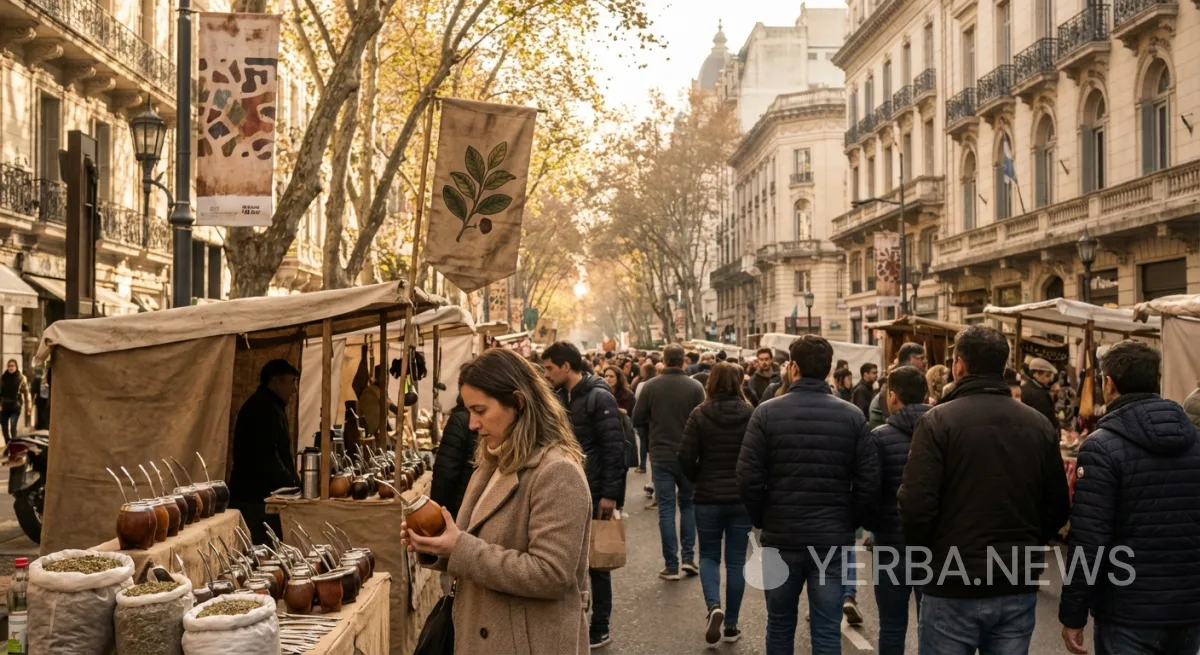
On Sunday, December 7, 2025, the government of Buenos Aires and the national yerba mate industry convened Mate BA — a free, open-air festival that transformed a stretch of Avenida de Mayo, one of the Argentine capital's most historically significant boulevards, into what organizers described as a 'mate corridor.' Running from 10 AM to 7 PM between Bernardo de Irigoyen and Piedras, the event brought together more than 30 producers of yerba mate, handcrafted gourds, bombillas, and accessories from across Argentina's producing regions, creating what Time Out Buenos Aires called 'The Great Gathering of Argentine Mate.'
The Mate Museum Opens Its Doors
The festival's centerpiece was the official inauguration of the Museo del Mate — Argentina's first museum dedicated exclusively to the history, culture, and material heritage of yerba mate — at Avenida de Mayo 853. The museum's permanent collection spans the commodity's journey from pre-Columbian Guaraní use through the Jesuit missions that first cultivated Ilex paraguariensis at scale, the industrialization of the yerba mate sector in Misiones and Corrientes provinces in the 20th century, and the contemporary global expansion of the category. By establishing the museum on Avenida de Mayo — a boulevard that connects the Casa Rosada (the presidential palace) to the National Congress — the organizers placed mate at the symbolic center of Argentine civic life.
Producers, Artisans, and Performance
The festival's 30+ producer stalls provided visitors with the opportunity to taste yerba mate from different terroirs and processing traditions: some exhibiting the bitter, smoky profiles of Misiones province, others the milder, more herbaceous character of southern Brazilian-influenced varieties from Corrientes. Alongside the leaf producers, artisans displayed handcrafted mate gourds — calabaza (gourd), palo santo (wood), ceramic, and silver — and bombillas (filtering straws) ranging from traditional alpaca silver to contemporary stainless steel designs. Live folk music and traditional dance performances provided the cultural backdrop, reinforcing the festival's thesis that mate is not merely a beverage but an integrated cultural system encompassing agriculture, craft, ritual, music, and social organization.
Cultural Politics of the Festival
Mate BA's timing — one week after National Mate Day (November 30, commemorating the birthday of Andrés Guazurary, an Indigenous Argentine leader who promoted yerba mate cultivation) — was deliberate. The festival sits within a broader institutional effort by the Argentine government and the INYM (Instituto Nacional de la Yerba Mate) to elevate mate from a domestic staple commodity to a recognized cultural heritage. This year's event took place against the backdrop of Argentina's 32% surge in yerba mate exports (reaching a record 57.98 million kilograms in 2025) and the ongoing growers' strike protesting below-cost farmgate prices — a juxtaposition that underscores the tension between mate's cultural celebration and its economic realities for the producers who grow it.
The opening of the Mate Museum, in particular, signals an institutionalization of mate culture that parallels what coffee (in Italy, Ethiopia, and Colombia) and wine (in France, Italy, and Spain) have undergone: the transition from a taken-for-granted daily commodity to a recognized heritage practice worthy of museum preservation, curatorial interpretation, and tourist engagement. For Buenos Aires — a city whose cultural identity is more typically associated with tango, steak, and Malbec — the museum's inauguration represents a formal addition of mate to the city's cultural canon.