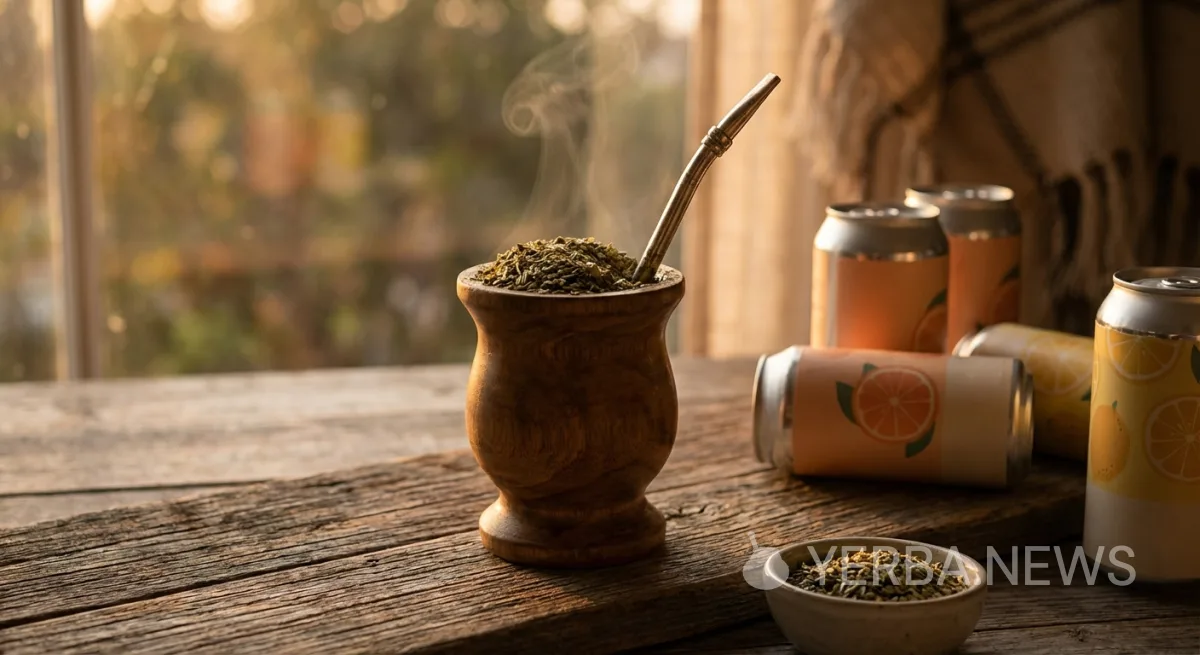
When Sabrina Carpenter sat down with Rolling Stone for her June 2025 cover story, the 26-year-old pop star rattled off the usual talking points — her new album 'Man's Best Friend,' the pressures of fame, and the constant scrutiny of her lyrics. But one off-hand confession sent ripples across an entire continent. 'My fans know that I have a terrible addiction to yerba mate, an Argentinian tea,' Carpenter told the magazine, before specifying that her preferred vehicle for the centuries-old South American beverage is a canned, limoncello-flavored variety she keeps stocked at all times.
The quote might have passed unnoticed in North America, where yerba mate is still a niche beverage gradually working its way into health-food aisles and tech-startup break rooms. But in Argentina, Uruguay, Paraguay, and southern Brazil — where mate is not merely a drink but a daily ritual, a social bond, and, in some regions, practically a national religion — Carpenter's description landed like a spark in dry grass.
"An Argentine Tea": Why Three Words Ignited a Continent
To understand why Carpenter's seemingly innocuous comment generated thousands of social-media reactions, memes, and earnest opinion columns across Latin America, one must first understand what mate means to the River Plate region. Yerba mate — scientifically classified as Ilex paraguariensis — is not simply a tea. It is a communal practice. A single gourd (the 'mate') is filled with dried, crushed leaves, saturated with hot water from a thermos, and passed clockwise among friends, family, or co-workers, each person drinking through a shared metal straw called a bombilla. The ritual is so deeply embedded in Argentine identity that the Instituto Nacional de la Yerba Mate (INYM) estimates that 92 percent of Argentine households consume yerba mate regularly.
Carpenter, by contrast, described a solitary experience involving a factory-sealed aluminum can. The cultural dissonance was immediate. 'She said mate is a tea. She said it's Argentine. She drinks it from a can with limoncello flavor,' one Argentine journalist wrote on social media, each clause escalating in mock outrage. 'At least she didn't say it was invented in Brooklyn.' Others were more generous, noting that any global attention toward the drink — however unorthodox the delivery system — ultimately benefits the yerba mate industry and the smallholder farmers who cultivate it in the subtropical provinces of Misiones and Corrientes.
The Science Behind the 'Addiction'
Carpenter's choice of the word 'addiction,' while hyperbolic, is not entirely without scientific basis. Yerba mate contains caffeine — approximately 80 milligrams per cup, roughly equivalent to a standard cup of brewed coffee — along with theobromine, the stimulant also found in chocolate, and a constellation of caffeoyl derivatives that function as potent antioxidants [1]. The combination produces what regular drinkers often describe as a sustained, focused alertness without the jitteriness associated with coffee, though peer-reviewed clinical evidence for this specific subjective distinction remains limited.
Beyond stimulation, the body of scientific literature on Ilex paraguariensis is substantial and growing. Studies have documented anti-inflammatory properties, potential cardiovascular benefits including reductions in LDL cholesterol, and metabolic effects that may support weight management. The plant's polyphenol content — a large group of antioxidants linked to reduced risk of numerous chronic diseases — has been shown in some laboratory studies to exceed that of green tea. Saponins present in the leaves contribute cholesterol-lowering and anti-inflammatory activity. The leaves also contain small quantities of vitamins C, B1 (thiamine), B2 (riboflavin), and B6, though not in amounts likely to constitute a significant dietary source on their own [1].
A $2.1 Billion Market Says the 'Obsession' Is Not Hers Alone
While social media debated whether Carpenter's canned limoncello mate counts as 'real' mate, the market data tells a story of accelerating global adoption that is rewriting the commercial landscape of the entire category. Industry analyses value the global yerba mate market at approximately $2.14 billion in 2026, with projections pointing toward $3.46 billion by 2035 at a compound annual growth rate of 5.48 percent. Within that expansion, the ready-to-drink (RTD) segment — exactly the format Carpenter favors — has emerged as the dominant growth engine, with year-over-year sales increases of approximately 65 percent.
The RTD boom is not happening in a vacuum. E-commerce sales of yerba mate products have surged roughly 60 percent year-over-year, and product innovation has accelerated across multiple dimensions: low-sugar formulations, carbonated variants, functional ingredient stacking (adaptogens, nootropics, added vitamins), and an ever-expanding flavor portfolio that spans far beyond Carpenter's limoncello — from mango passionfruit and guava to traditional smoked blends reimagined in convenient single-serve packaging.
| Brand | Format | Key Innovation | Target Market |
|---|---|---|---|
| Yerba Madre (formerly Guayakí) | Canned RTD | Shade-grown certification, athlete sponsorships | US mainstream / sports |
| YATE | Sparkling canned | Nightlife & electronic music positioning | Urban social drinkers |
| Pura Vida | Canned RTD | Adaptogen + nootropic stacking (Lion's Mane, Ashwagandha) | Wellness-focused consumers |
| NutraTea | Tea bags | Functional blends (Gotu Kola + Yerba Mate) | UK/European health market |
| Sacred Dose | Oral pouches | Tobacco-alternative nicotine-free delivery | Convenience / on-the-go |
The Celebrity Effect: From Football Pitches to Red Carpets
Carpenter is far from the first celebrity to bring attention to yerba mate, though she may be the first to do so while simultaneously confounding South Americans with her delivery format. The drink has long enjoyed an almost cult-like following among elite athletes, particularly those with connections to Argentine and Uruguayan football culture. Lionel Messi is perhaps the most visible advocate — photographs of the eight-time Ballon d'Or winner carrying his mate gourd and thermos through airports, hotel lobbies, and training grounds have become iconic images in the sport. His former Barcelona teammates Antoine Griezmann and Neymar Jr., as well as Luis Suárez and numerous other footballers, adopted the habit.
The celebrity footprint extends well beyond the pitch. Leonardo DiCaprio has been photographed drinking mate on multiple occasions. Madonna reportedly incorporated it during filming in Argentina. Tom Hardy, Jason Momoa, Gwyneth Paltrow, and Jennifer Lawrence have all been documented with the drink. Even Pope Francis, a Buenos Aires native, is a known mate devotee. But until Carpenter's Rolling Stone confession, the celebrity endorsements had largely originated either from Latin Americans sharing their own culture or from Hollywood figures who encountered mate through travel and personal connections. Carpenter represents something different: a Gen Z pop icon discovering the beverage through its commercialized, Americanized RTD form and broadcasting the discovery to an audience of tens of millions.
Lollapalooza and the Cultural Collision Course
The timing of Carpenter's yerba mate moment could not be more cinematically poised. In March 2026 — just weeks after the Rolling Stone interview resurfaced in South American media — Carpenter is headlining Lollapalooza Argentina at the Hipódromo de San Isidro in Buenos Aires (March 13–15), Lollapalooza Chile at Parque O'Higgins in Santiago (March 13–15), and Lollapalooza Brasil at the Autódromo de Interlagos in São Paulo (March 20–22) [2]. These performances mark her first time ever performing in South America.
The juxtaposition is irresistible: a pop star who publicly declared her love for canned mate arriving in the homeland of traditional mate culture. Argentine fans have already begun speculating online about whether concert organizers will present Carpenter with a proper mate set on stage — a gourd, a bombilla, and a thermos of hot water — in what would amount to a gentle cultural initiation broadcast to the festival's massive international audience. Whether she accepts the gourd or politely returns to her limoncello can, the moment will say something about the evolving relationship between tradition and globalization in the food-and-beverage space.
Traditional vs. RTD: A False Dichotomy?
The instinct to frame the debate as 'authentic versus commercial' is understandable but ultimately reductive. The yerba mate industry is not a zero-sum game. Argentina's total yerba mate consumption reached approximately 300 million kilograms last year, the vast majority consumed in the traditional gourd-and-bombilla format. That consumption is not threatened by flavored cans sold in American convenience stores. If anything, the RTD category creates an entirely new consumption occasion — one that coexists with, rather than replaces, the traditional ritual.
This coexistence model has historical precedent. Japanese matcha went through an analogous transformation: purists initially recoiled at matcha lattes, matcha Kit Kats, and matcha-flavored everything, but the commercial boom ultimately drove renewed interest in traditional tea ceremony culture. Specialty matcha producers now command premium prices precisely because mass-market exposure created baseline awareness. The same dynamic appears to be unfolding with yerba mate. Brands like Yerba Madre (formerly Guayakí), which recently obtained the world's first 'shade-grown yerba mate' certification and signed 20 athlete ambassadors across seven sports, are explicitly positioning their RTD products as gateways to deeper cultural engagement with the beverage.
The Bigger Picture: When Pop Culture Meets Agricultural Economy
Beyond the entertaining cultural friction, Carpenter's offhand comment illuminates a commercial reality with significant economic consequences. The provinces of Misiones and Corrientes, where virtually all of Argentina's yerba mate is cultivated, are among the country's poorest regions. The global RTD boom directly affects these communities, creating both opportunities and tensions. Higher international demand can raise farmgate prices, but it can also incentivize monoculture and accelerate land conversion, placing stress on the Atlantic Forest ecosystems that have historically sheltered shade-grown yerba mate under the canopy.
Progressive brands have begun addressing this tension. Regenerative agriculture initiatives in the region aim to measure and improve carbon sequestration in yerba mate plantations, and several producers have adopted certification standards that mandate biodiversity preservation. Whether these efforts can scale fast enough to match the appetite of a market projected to grow by nearly $1.3 billion over the next decade remains to be seen.
A Gourd, a Can, and What Comes Next
Sabrina Carpenter almost certainly had no intention of becoming a protagonist in the long-running global conversation about yerba mate's identity. She mentioned a beverage she enjoys. She used imprecise terminology. She moved on. But the intensity of the reaction reveals how deeply mate is intertwined with national identity in South America — and how potent celebrity influence remains in shaping consumer awareness of what, until recently, was one of the world's best-kept-secret stimulants.
When she takes the stage in Buenos Aires on March 14, an audience of tens of thousands will likely be holding their mates and thermoses alongside their phones and glowsticks. For a brief, intoxicating moment, the ritual will be what it has always been: communal, immediate, and alive. Whether a few of those concertgoers later reach for a limoncello-flavored can — well, that might just be the beginning of a different kind of tradition.