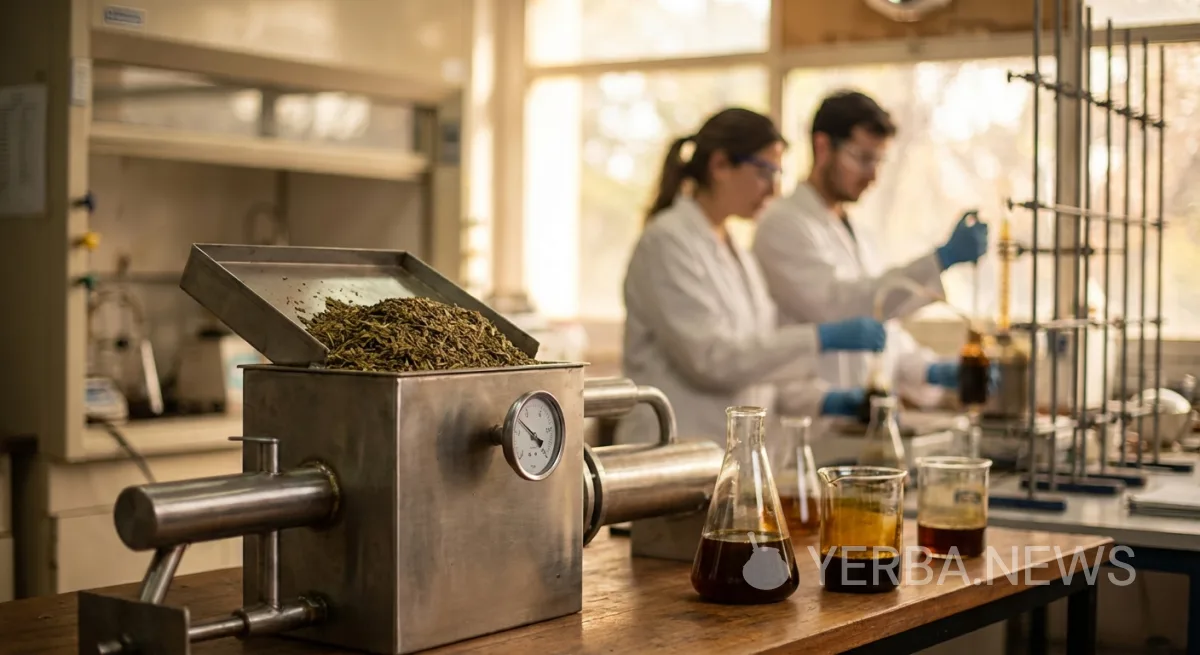
Argentina generates more than 220,000 tons of spent yerba mate annually — the soggy, depleted leaf material that remains after the infusion has been consumed. Until recently, this biomass was treated as waste, destined for landfills or compost piles. But a research team at CONICET (Argentina's National Scientific and Technical Research Council) in Mendoza, working in collaboration with the University of Groningen in the Netherlands, has demonstrated that this overlooked residue can be converted into a portfolio of industrially valuable products through a process called pyrolysis — potentially transforming one of South America's largest organic waste streams into a circular-economy revenue source.
The Pyrolysis Process
Pyrolysis is the thermal decomposition of organic material in the absence of oxygen, typically conducted at temperatures around 550°C. When applied to spent yerba mate (SYM), the process yields three distinct product fractions: bio-oil (a liquid condensate), biochar (a solid carbon residue), and combustible gases (primarily CO₂, H₂, and CH₄). The CONICET team has designed and validated low-cost experimental reactors specifically engineered to process yerba mate biomass, making the technology potentially accessible to small and medium-scale operators in Argentina's yerba mate–producing regions.
What makes yerba mate waste particularly attractive as a pyrolysis feedstock is the composition of the resulting bio-oil. Analysis reveals that SYM-derived bio-oil is unusually rich in methoxyphenols — a class of aromatic organic compounds that command significant value in the chemical, pharmaceutical, and fragrance industries. These compounds serve as precursors for the production of plastics, resins, aromas, and renewable fuels, positioning yerba mate bio-oil as a potential alternative to petroleum-derived feedstocks for these applications.
Pre-Extraction: Caffeine and Minerals First
The researchers have developed a sequential processing approach that maximizes value extraction from the waste stream. Before pyrolysis, spent yerba mate undergoes pre-treatment to isolate commercially valuable components that would otherwise be destroyed by high-temperature processing. This pre-extraction step recovers caffeine — which retains residual concentration in used leaves — and a suite of minerals including calcium, potassium, magnesium, and manganese, all of which have established markets in the nutraceutical and agricultural supplement industries. Only after these high-value, temperature-sensitive compounds have been recovered does the remaining biomass enter the pyrolysis reactor.
Closing the Loop: Self-Powering Biorefineries
One of the most elegant aspects of the proposed biorefinery model is its potential for energy self-sufficiency. The combustible gases generated during pyrolysis — hydrogen, methane, and carbon dioxide — can be captured and used to power the reactor system itself, reducing or eliminating the need for external energy inputs. Combined with the biochar byproduct's agricultural applications (as a soil amendment that improves water retention, nutrient availability, and carbon sequestration), the model approaches a zero-waste circular economy: every fraction of the original yerba mate waste stream generates either a saleable product or a process input.
Scale and Economic Potential
The scale of the opportunity is significant. With Argentina alone generating over 220,000 tons of spent yerba mate per year — and the combined output from Argentina, Brazil, and Paraguay exceeding this figure substantially — the total addressable feedstock represents one of the largest concentrated organic waste streams in the Southern Hemisphere. If even a modest fraction of this waste were processed through pyrolysis biorefineries, the resulting bio-oil output could supply meaningful volumes of methoxyphenols to industries currently dependent on petroleum-derived aromatic compounds.
The CONICET-Groningen collaboration has published its findings through multiple channels, including Noticias Ambientales, Radio Nacional, and peer-reviewed academic publications. The researchers describe the work as a proof-of-concept that requires scaling validation — specifically, the transition from laboratory-scale reactors to pilot plants capable of continuous processing. If scaling proves viable, the technology could create an entirely new value chain for Argentina's yerba mate industry: one in which the waste generated by 80 million daily drinkers becomes the feedstock for a renewable chemical industry.