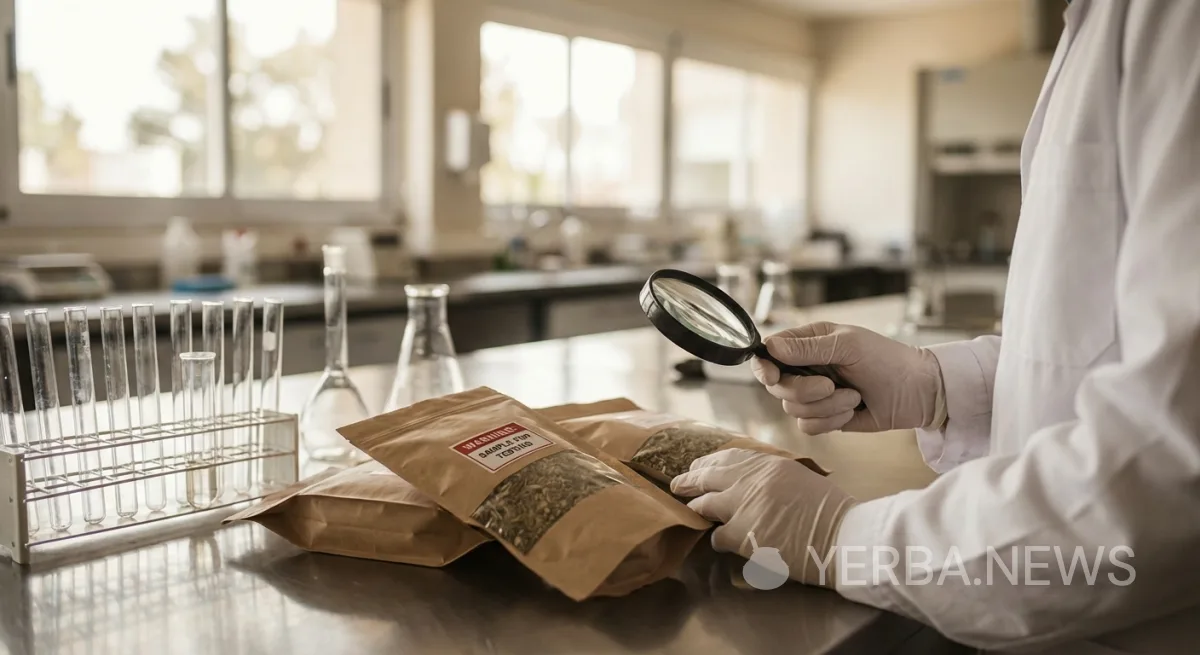
Over a seven-month period from August 2025 to February 2026, Malta's Food Safety and Security Authority issued three separate consumer warnings for yerba mate products sold in the island nation, each triggered by laboratory detection of substances classified as carcinogenic by European regulatory authorities. The recalls — communicated through the EU's Rapid Alert System for Food and Feed (RASFF) — affected three distinct brands and identified contamination with anthraquinone, polycyclic aromatic hydrocarbons (PAHs), and benzo(a)pyrene.
The Three Recalls
- Recall timeline (all verified from gov.mt and Times of Malta):
- August 6, 2025: Piporé Yerba Mate Tea (250g, origin Argentina, BBE 31/12/2025, Lot LOS-NR.77830/E) — elevated anthraquinone levels
- October 3, 2025: Kharta Khadra Yerba Mate Tea (250g green package, BBE 31/08/2026) — elevated anthraquinone levels
- February 26, 2026: Elaborada Yerba Mate Tea (white packaging Lot 0144 + green packaging Lot 0234, 250g, BBE April 2028) — elevated anthraquinone, PAHs, and benzo(a)pyrene
The Contaminants
Anthraquinone is a polycyclic organic compound that the European Commission classifies as a Category 2 carcinogen — a substance 'suspected of causing cancer in humans.' It can enter agricultural products through multiple pathways: as a residue from certain pesticides, as a byproduct of combustion during drying processes, or through contamination from packaging materials. Its detection in yerba mate is not entirely surprising, given that traditional yerba mate processing involves a 'sapecado' stage in which the fresh leaves are rapidly exposed to direct flame or intense heat to halt enzymatic oxidation — a step that can generate PAHs and their derivatives if combustion parameters are not carefully controlled.
Polycyclic aromatic hydrocarbons (PAHs) are a broader class of combustion byproducts, of which benzo(a)pyrene is the most toxicologically significant member. The International Agency for Research on Cancer (IARC) classifies benzo(a)pyrene as a Group 1 carcinogen — the highest classification, indicating sufficient evidence of carcinogenicity in humans. Its detection in the February 2026 Elaborada recall — alongside anthraquinone — suggests that the contamination may be linked to the drying or toasting process rather than to agricultural pesticide use, as PAHs and benzo(a)pyrene are characteristically produced by incomplete combustion of organic material.
Implications for the Global Supply Chain
Malta's consumer market for yerba mate is small — the island nation has a population of approximately 520,000 — but the RASFF system through which these alerts are communicated operates across all 27 EU member states plus Iceland, Liechtenstein, Norway, and Switzerland. A RASFF notification for a product imported into Malta can trigger border rejections and increased testing in every other RASFF member country, making these recalls disproportionately consequential for the brands involved.
For the yerba mate industry, the repeated detection of carcinogenic compounds in exported products — three recalls involving three different brands within seven months — raises systemic questions about processing controls, particularly at the sapecado (flash-drying) stage where combustion byproducts are most likely to form. Argentina's INYM and the corresponding regulatory bodies in Brazil and Paraguay may need to formalize maximum residue limits for anthraquinone and PAHs that are specifically calibrated to yerba mate's unique processing requirements, rather than relying on generic food-safety thresholds that were not designed with fire-dried botanicals in mind.