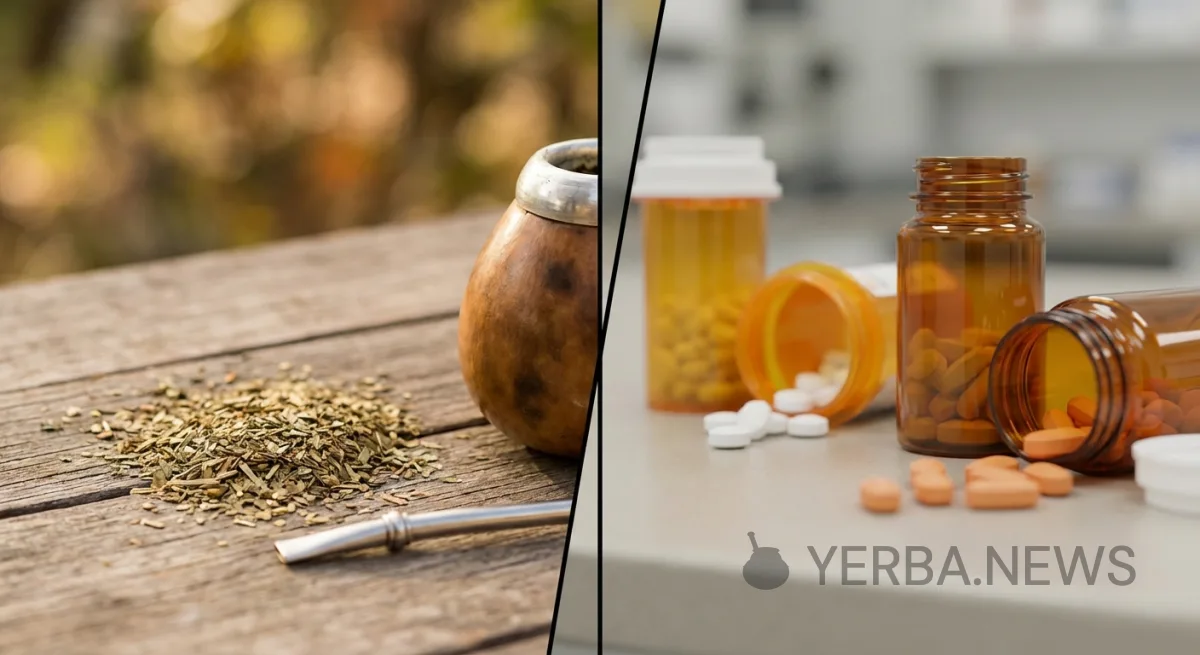
A viral TikTok trend has popularized the claim that yerba mate functions as a 'natural Ozempic' — an 'Rx-free' alternative to semaglutide-based GLP-1 receptor agonists like Wegovy and Ozempic, which have become the fastest-growing pharmaceutical category in history. The claim, which has accumulated millions of views across multiple TikTok creators, is built on a kernel of legitimate science: yerba mate does contain compounds that interact with metabolic pathways involved in appetite regulation. But the extrapolation from 'interacts with metabolic pathways' to 'works like Wegovy' collapses under the weight of the actual clinical evidence.
What the 2025 Clinical Trial Actually Found
A 2025 randomized, controlled human trial — the most rigorous type of clinical study — directly tested the hypothesis that yerba mate stimulates GLP-1 production in humans. The results were unambiguous: while yerba mate consumption decreased ghrelin levels (a 'hunger hormone' that stimulates appetite), GLP-1 levels remained unchanged after consumption. This is a critical distinction. Wegovy and Ozempic work by mimicking GLP-1 at pharmacological concentrations, binding to GLP-1 receptors throughout the body — in the pancreas (stimulating insulin secretion), in the brain (suppressing appetite), and in the stomach (slowing gastric emptying). If yerba mate does not significantly increase GLP-1 in humans, the entire mechanistic comparison to semaglutide falls apart.
The Animal Model Problem
The TikTok claims appear to derive from legitimate animal studies — primarily in rodents — that showed yerba mate extracts could induce GLP-1 release in vitro or in animal models. This is not unusual: thousands of plant compounds show biological activity in animal models that does not translate to clinically meaningful effects in humans. The Andrew Huberman Lab podcast has discussed yerba mate's potential GLP-1-stimulating properties, but with the important caveat that the magnitude of GLP-1 stimulation from yerba mate is 'significantly lower than that achieved through pharmaceutical means.' The difference is not marginal — it is orders of magnitude. Semaglutide (the active ingredient in both Wegovy and Ozempic) produces sustained, supraphysiological GLP-1 receptor activation that results in average weight loss of approximately 15% of body weight in clinical trials. No food, beverage, or supplement has come close to replicating this effect.
What Yerba Mate Actually Does for Weight
This is not to say that yerba mate has no metabolic effects. Doctors consulted by multiple publications describe the weight-related effects of yerba mate as 'subtle and short-lived.' Yerba mate's caffeine content (typically 30–85 mg per serving) provides a mild thermogenic effect — increasing basal metabolic rate by a small percentage for a few hours after consumption. Some studies suggest yerba mate may increase fat oxidation during exercise, helping the body preferentially burn fat rather than carbohydrate during physical activity. And the ghrelin-suppressing effect documented in the 2025 trial is a legitimate, if modest, appetite-modulating mechanism. But these effects are comparable to those of green tea or coffee — they are real but small, and they do not constitute a substitute for pharmacological GLP-1 receptor agonism.
The Medical Risk of the Comparison
Medical professionals have flagged a concrete clinical risk in the 'natural Ozempic' framing: patients who are currently taking GLP-1 medications like Wegovy or Ozempic may believe that switching to yerba mate would provide equivalent therapeutic benefit, potentially discontinuing prescription medication without medical supervision. Additionally, patients who combine yerba mate with GLP-1 drugs without informing their physician may experience overlapping effects on blood sugar and appetite that could increase the risk of hypoglycemia or nutrient deficiencies. The Valley Forge Weight Management Center has explicitly recommended against combining yerba mate with GLP-1 medications without medical supervision. For the yerba mate industry, the TikTok trend presents a familiar dilemma: the viral attention drives short-term consumer interest, but the inflated claims create a credibility deficit that undermines the plant's genuine, evidence-based health attributes.