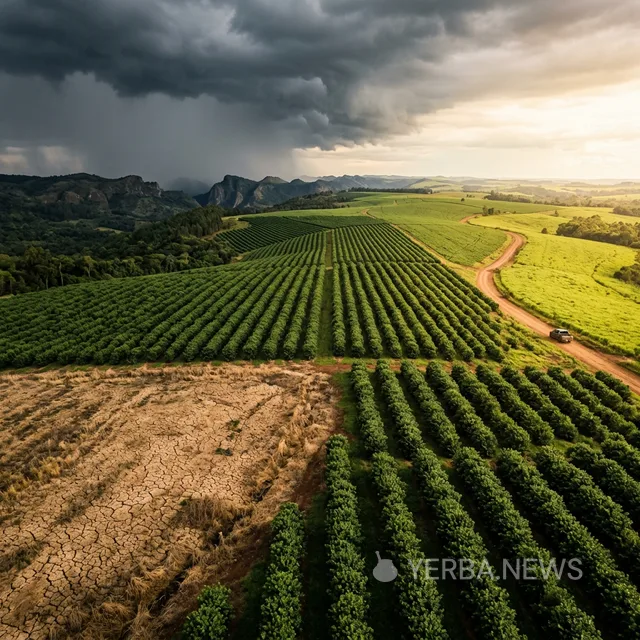
For more than five centuries, yerba mate has been the lifeblood of South American culture — a communal ritual passed from the Guaraní people to Spanish colonists, and eventually to the 30 million people who now drink it daily across Argentina, Brazil, Paraguay, and Uruguay. But the subtropical forests where Ilex paraguariensis thrives are changing faster than the plant can adapt, and the consequences are beginning to cascade through one of the region's most economically vital agricultural sectors.
The Numbers Behind the Crisis
A 2024 study conducted by Brazilian researchers and reported by Dialogue Earth paints a sobering picture. Under moderate greenhouse gas emissions scenarios, the areas suitable for yerba mate cultivation are projected to shrink significantly in both Paraguay and Brazil — the crop's two largest producers after Argentina. In 2023, Argentina led global production with 982,000 tonnes, followed by Brazil at 736,000 tonnes and Paraguay at 160,000 tonnes. Together, these three nations account for virtually all of the world's yerba mate supply, a concentration of production that transforms a regional climate problem into a global supply chain vulnerability.
Research using CMIP6 climate model projections reinforces the alarm: escalating average air temperatures and decreasing rainfall are steadily eroding the geographic zones where yerba mate can be commercially cultivated. The plant demands consistent moisture and moderate temperatures — conditions that are becoming increasingly rare in its traditional heartlands.
It's Not Just the Heat — It's the Water
The climate threat to yerba mate is more nuanced than simple warming. As Dialogue Earth's reporting highlights, the real danger lies in changing precipitation patterns. Total annual rainfall in parts of Argentina's Misiones province — the country's yerba mate heartland — hasn't necessarily declined. Instead, rain events have become more concentrated and intense, falling in short, violent bursts rather than the steady, distributed showers the crop requires.
This shift is compounded by decades of soil degradation. Years of monoculture and deforestation have stripped the region's red laterite soils of their natural water-retention capacity. When heavy rains arrive, water runs off compacted surfaces rather than percolating down to root systems. The result is a cruel paradox: farmers can receive adequate annual rainfall while their plants still die of thirst.
Winners and Losers in a Warming World
Not every projection is bleak. The same Brazilian study that forecasts contraction in Paraguay and Brazil identifies Uruguay as a potential beneficiary. Suitable cultivation areas there could remain stable or even expand, potentially catalyzing an entirely new yerba mate industry in a country that has historically been a consumer rather than a producer. For Uruguay — already the world's highest per-capita consumer of yerba mate — domestic production would represent a significant shift in trade dynamics and agricultural identity.
Yet the prospect of Uruguayan yerba mate also raises questions about quality and tradition. Terroir matters for mate as much as it does for wine. The mineral composition of Misiones soil, the altitude of Brazilian plantations in Paraná state, the wild-harvested leaves from Paraguayan forests — each produces a distinctly different product. Whether Uruguayan mate could match the complexity consumers expect remains an open question.
Indigenous Knowledge Meets Modern Adaptation
Some of the most promising responses to the crisis are emerging from the communities with the longest relationship to the plant. In Paraguay, Indigenous Guaraní communities — the original cultivators of yerba mate — have begun nursery programs to grow seedlings as wild populations become scarcer. According to the United Nations, these initiatives serve a dual purpose: preserving traditional ecological knowledge while creating climate-resilient agricultural models that could inform broader industry practices.
Meanwhile, a growing number of producers are turning to shade-grown and regenerative organic farming methods. By cultivating yerba mate under the forest canopy rather than in cleared fields, these operations mimic the plant's natural habitat. The approach naturally regulates soil temperature, retains moisture, and preserves biodiversity — addressing several climate vulnerabilities simultaneously. Some certified shade-grown operations, sourced from indigenous and family farmers, are beginning to command premium prices in North American and European export markets.
A $2 Billion Industry at a Crossroads
The stakes extend well beyond agriculture. Yerba mate is increasingly finding its way into energy drinks, cosmetics, nutritional supplements, and functional foods — a diversification trend that has expanded global demand precisely as supply becomes less certain. The crop is economically critical for hundreds of thousands of smallholder farmers in Argentina's northeastern provinces and Brazil's southern states, regions where alternative employment options are limited.
The irony is stark: yerba mate's rise as a globally fashionable superfood coincides exactly with the acceleration of the climate forces that threaten its production. Companies like Yerba Madre — which recently rebranded from Guayakí and announced regenerative organic certification — are betting that sustainability and premium positioning can insulate the industry from supply shocks. But whether market-driven adaptation can outpace the rate of environmental change is the question that will define the next decade for South America's most culturally important crop.
The Road Ahead
The future of yerba mate will likely be determined by three converging forces: the speed of climate change in subtropical South America, the adoption rate of regenerative agricultural practices, and the willingness of governments in Argentina, Brazil, and Paraguay to invest in research and soil restoration programs. The CMIP6 projections don't leave much room for complacency. But the resourcefulness of indigenous communities, the economic incentives created by global demand, and the proven viability of shade-grown methods offer a credible — if narrow — path to resilience. The gourd isn't empty yet. But the water is getting hotter.