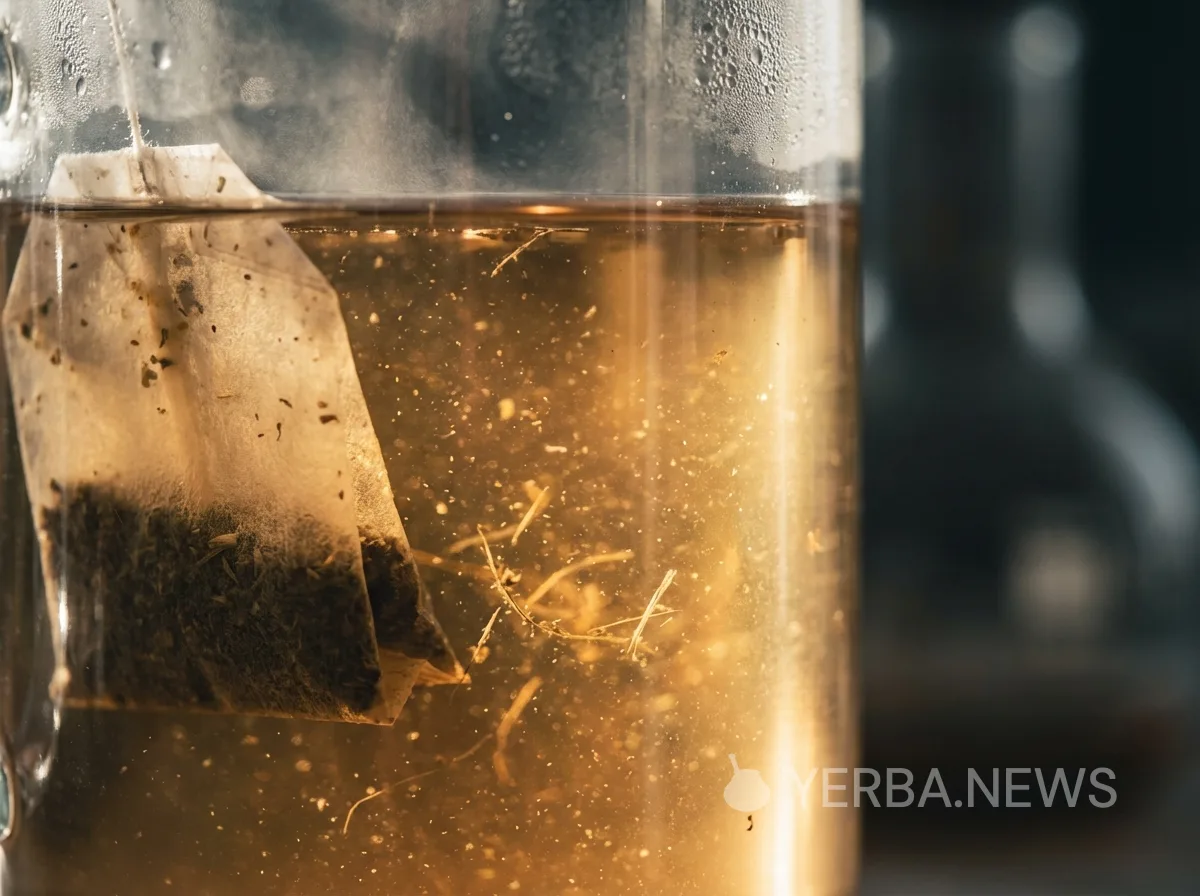
Research from the Autonomous University of Barcelona (UAB), conducted under the EU-funded PlasticHeal project and reported by food-safety.com, earth.com, and other science outlets in 2024-2025, has produced findings that should concern every consumer of bagged tea — including the growing number of yerba mate drinkers who use tea-bag formats rather than traditional loose-leaf preparation. The central finding: polypropylene tea bags release approximately 1.2 billion nano- and microplastic particles per milliliter of brewed liquid.
The Numbers, Material by Material
The UAB researchers tested tea bags made from three common polymer materials, measuring particle release under standard brewing conditions (95°C water, steeping times consistent with consumer use). The results varied dramatically by material:
The particles ranged from 136 to 244 nanometers in diameter — sizes well below the threshold of visibility and within the range that allows absorption by human intestinal epithelial cells. Using scanning electron microscopy (SEM) and nanoparticle tracking analysis (NTA), the researchers confirmed that these particles are not inert fragments that pass through the digestive system but are instead taken up by cells, with the potential to enter the bloodstream and distribute throughout the body.
Broader Confirmation
The UAB findings are consistent with a study published in Science of the Total Environment in September 2025 that examined over 150 beverage samples and found that 100% of tested beverages contained microplastics, with hot tea demonstrating the highest abundance. Temperature is a critical variable: heat accelerates the breakdown of polymer material, meaning that beverages prepared with near-boiling water — including mate cocido, the bagged form of yerba mate — are exposed to substantially higher particle loads than cold-brewed or ambient-temperature drinks. A separate meta-analysis of 103 studies, reported by packnode.org, confirmed that plastic food packaging is a consistent source of microplastic contamination even under normal use conditions.
Implications for Yerba Mate
For the yerba mate category, the microplastics research creates a clear safety distinction between traditional and modern preparation methods. The ancestral practice of drinking mate — loose leaf packed into a gourd (mate or cuia), with hot water poured directly over the leaf and consumed through a metal bombilla — involves no polymer contact whatsoever. The same is true for traditional tereré preparation in Paraguay. In contrast, the rapidly growing 'mate cocido' segment — bagged yerba mate designed for cup brewing, analogous to a standard tea bag — typically uses polypropylene or nylon bag materials. The research suggests that consumers choosing bagged yerba mate are exposing themselves to particle loads that do not exist in traditional preparation.
The findings add a public-health dimension to what has historically been a cultural debate. Traditionalists in Argentina, Uruguay, and Paraguay have long argued that mate should be consumed 'properly' — from a gourd, with a bombilla, using loose leaf. The microplastics data provides an empirical basis for that position: the traditional method is not merely culturally authentic but demonstrably safer from a materials-exposure standpoint. For brands like Yerba Madre, which recently relaunched its Traditional Air-Dried Loose Leaf with Regenerative Organic Certified Gold status, the research represents an additional marketing argument: loose leaf is not just premium, it is polymer-free.